Enjoy a walk, drive or cycle ride around the Sussex village of Brightling to see the intriguing follies built by John 'Mad Jack' Fuller. Download a pdf of the map and guide here.
Showing posts with label Observatory. Show all posts
Showing posts with label Observatory. Show all posts
Monday, August 30, 2021


Monday, March 28, 2016


Friday, February 13, 2015
Brightling Observatory For Sale in 1953

Brightling Observatory Is For Sale
Brightling Observatory, built by "Mad Jack" Fuller over 140 years ago, is for sale again. It was built on the site of a beacon by Fuller, who was the Squire of Brightling, and a Sussex M.P. from 1801 to 1812.
Some time ago it was sold to the Gypsum Mines by the Squire, Mr. T.P. Tew, and later resold and redecorated for the use as a private residence. It was recently bought by Mr. Grinling of Fair Court, Wadhurst.
The Observatory is almost s well known as the celebrated Brightling Needle nearby, which also owes its origin to Fuller, who died in 1834.
It stands, as if in answer to Fuller's Sugar Loaf "Folly" as testimony to the deeper side of Fuller's character as a cultivated gentleman and a patron of science.
Designed by the great architect Sir Robert Smirke, who built the British Museum, the observatory was erected in 1810, being intended by Fuller for the use of he eminent astronomer, Herschel whose bust could be seen inside the building for many years.
The astronomical instruments were removed about 1908, and the building used as a reading room and later converted into a cottage.
Brighting Observatory Sale

Friday, May 23, 1919 - Page 1
Thursday, May 29th, 1919
THE OBSERVATORY, BRIGHTLING,
MESSERS,
E. WATSON & SON
Sale to commence at 1.30 p.m.
No Catalogues. Auction and Estate Offices, Heathfield (Phone No. 11).
Saturday, March 16, 2013
Site Unseen The Pyramid, Brightling
This article, by Andrew John Davies, appeared in The Independent on Tuesday 12 December 1995. Davies likens actor Sir Robert Stephens, who died on 12 November 1995, to "those full-bodied and memorable individuals who live life to its utmost and devil take the consequences" . Mad Jack Mytton, Lord Rokeby, John Elwes and Mad Jack Fuller are offered as examples of larger than life characters.
Of Fuller, Davies writes, "His house has an observatory which allowed the servants to peer through a telescope and spot the master returning home from London.". It seems he is confusing The Tower with the Observatory, neither of which are actually in Fuller's house Rose Hill. He also states the the Obelisk or Brightling Needle was erected to "commemorate the defeat of Napoleon in 1815." Although one may conjecture that this is the case, there is scant evidence to support this claim.
I wonder what Davies is referring to when he closes with, "Guide books are normally available inside the church". Does he mean the Brightling Church Guide by Diana Boyd?
Of Fuller, Davies writes, "His house has an observatory which allowed the servants to peer through a telescope and spot the master returning home from London.". It seems he is confusing The Tower with the Observatory, neither of which are actually in Fuller's house Rose Hill. He also states the the Obelisk or Brightling Needle was erected to "commemorate the defeat of Napoleon in 1815." Although one may conjecture that this is the case, there is scant evidence to support this claim.
I wonder what Davies is referring to when he closes with, "Guide books are normally available inside the church". Does he mean the Brightling Church Guide by Diana Boyd?
Tuesday, March 05, 2013
Postcard 1: The Observatory, Brightling

Publisher unknown.
To - Miss A. Buss, Khartoum, Magdalen Rd, Bexhill On Sea (undated).
Dear Ciss
Just a few lines to tell you that Granny Buss is ill and Aunt Hartie is home for the Winter. Grandfather wired for her to come yesterday. Please tell Aunt Lou.
From Nell
Any help identifying the sender and recipient would be gratefully received. I believe the house, Khartoum, was at 23 Magdalen Road.

Saturday, March 02, 2013
A Village's Queer Buildings by Frederick John
The Sussex County Magazine October 1928, No. 10 Vol. II, pages 442 - 443

John asserts that without John Fuller and the Needle, Brightling "would have achieved little fame". It would be an unremarkable Sussex village. He writes, " Every summer huge chars-a-bancs labour up from the coast resorts to the altitude of 646 feet, bringing their loads of curious trippers to gaze a the famous Needle, and to speculate vaguely on its origin and purpose." One can visualize these open topped vehicles, very popular in the 1920s, filled with holiday makers from Eastbourne or Hastings visiting Brightling on day outings.
Interestingly, John refers to Fuller's buildings as "masonic enigmas". Pyramids and obelisks have long been considered symbols of freemasonry. This is not the first allusion that John Fuller was a mason that I've encountered. I have yet to find concrete evidence to support this notion, however.
This article is illustrated with charming ink drawings of the observatory, Brightling Needle and "Mad Jack's" Mausoleum (above). The name of the illustrator is difficult to read but the surname appears to be Boulter-Cooke. A writer and illustrator named Mabel Adeline Boulter-Cooke made contributions to The Sussex County Magazine around the same time. Could this be her work or that of a relative?

John asserts that without John Fuller and the Needle, Brightling "would have achieved little fame". It would be an unremarkable Sussex village. He writes, " Every summer huge chars-a-bancs labour up from the coast resorts to the altitude of 646 feet, bringing their loads of curious trippers to gaze a the famous Needle, and to speculate vaguely on its origin and purpose." One can visualize these open topped vehicles, very popular in the 1920s, filled with holiday makers from Eastbourne or Hastings visiting Brightling on day outings.
Interestingly, John refers to Fuller's buildings as "masonic enigmas". Pyramids and obelisks have long been considered symbols of freemasonry. This is not the first allusion that John Fuller was a mason that I've encountered. I have yet to find concrete evidence to support this notion, however.
This article is illustrated with charming ink drawings of the observatory, Brightling Needle and "Mad Jack's" Mausoleum (above). The name of the illustrator is difficult to read but the surname appears to be Boulter-Cooke. A writer and illustrator named Mabel Adeline Boulter-Cooke made contributions to The Sussex County Magazine around the same time. Could this be her work or that of a relative?
Monday, October 23, 2006
Was Jack Fuller a smuggler?

"Some say…an intriguing theory recently put forward by one of the foremost authorities on Sussex is that those follies were part of a great smuggling enterprise. Mad Jack, with money, personality and intelligence, used the Observatory as a look-out post; it commands wide coastal views. Belle Tout is said to have served the same purpose, though it could have served no purpose at all during those frequent mists. The follies were on smugglers’ routes; they were hollow, and the seamen hid the goods there to be collected by the land men. Presumably the follies, being comparatively few in number, were only occasionally used as hiding-places, or the excise men would have had a much simpler task. Yet how does the Needle fit into that theory? The main object was to get the goods away quickly – not to run up the highest Down in the area for a cache that might or might not be there. Perhaps the Needle’s role was merely negative – a genuine folly adding weight to the deception about the others.
Mad Jack was in the habit of travelling in a heavily built barouche, carrying pistols and food and attended by at least one outrider, ostensibly as protection against footpads. A man who so fully enjoyed his wealth would not take kindly to the prospect of its being snatched way. Was it also for protection against rival smuggling gangs? It could hardly have been fro protection against the excise en. In his social position as landowner, philanthropist and Member of Parliament, a confrontation with the law would entail the loss of much, if not all he most valued. "
Source: Curious Sussex, by Mary Delorme – ISBN 07090-2970-5
St Edmundsbury Press Limited, 1987, pp 72 -73.
Wednesday, January 05, 2005


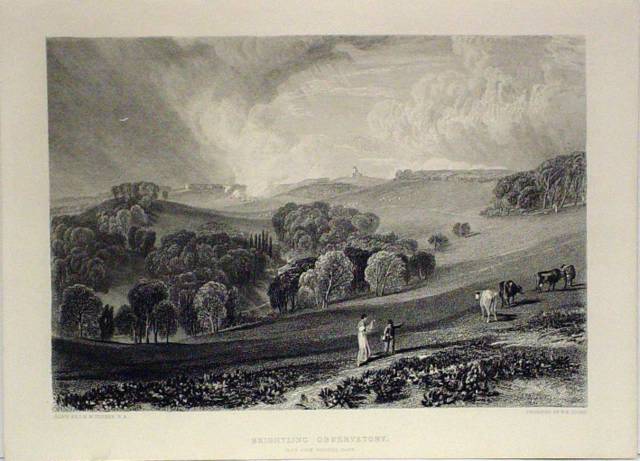
Fuller & Turner
"Between 1810 and the early 1820s Turner worked closely for two very different patrons, whose quite specific interests were given lasting form as a result of their connection with the artist. The first was John Fuller (known as 'Mad Jack': 1757-1834), who was the Tory MP for Sussex between 1801 and 1812. Like Beckford, his wealth derived from sugar plantations in the West Indies, and he was accordingly a vocal supporter of slavery. The connection with Turner began in 1810 with a request for a set of four watercolours showing Fuller's Sussex estate, Rosehill, and those of other neighbouring country houses. At much the same time Turner produced an oil painting of Rosehill though this is perhaps the least involving of his country house pictures; the strongly delineated areas of shadow across the middle distance creates an awkward transition, as the eye travels towards the distant speck of the mansion. He subsequently painted further views recording the lush undulating landscape to the north and west of Hastings, much of which was owned by Fuller. One of these later watercolours includes the observatory Fuller constructed high on the brow of a hill in Brightling Park, where he pursued his amateur interest in astronomy. However, its diminutive scale in the image suggests that Turner used the commission to emphasize the beauties of the scenery, instead of the characteristic interests of his patron. "
Turner at Petworth, Christopher Rowell, Ian Warrell & David Blayney Brown, pp. 52
Turner at Petworth, Christopher Rowell, Ian Warrell & David Blayney Brown, pp. 52
Monday, August 16, 2004
Mad Jack Fuller's Obituary
Gentleman's Magazine
July 1834 pp 106 - 107
JOHN FULLER, Esq.
April 11. In Devonshire place, aged
77, John Fuller, Esq. of Rose Hill, Sus-
sex, formerly M.P. for that county.
This gentleman was the son of John
Rose Fuller, esq. He succeeded in es-
tate his uncle Rose Fuller, Esq. M.P.
for Rye (ob. 1777) who was the younger
son of Mr. Thomas Fuller, the purchaser
of the estate, and builder of the house,
Rose Hill, by Elizabeth, daughter of Mr.
Rose, of Jamaica.
Mr. Fuller was first elected to Parlia-
ment for Southampton in Feb. 1780, and
having been rechosen at the general elec-
tion of the same year, he sat for that town
until the dissolution in 1784. He served
the office of Sheriff of Sussex in 1797.
In 1801, on the elevation to the peer-
age of the Rt. Hon. T. Pelham (by the
title of Earl of Chichester), Mr. Fuller
became a candidate for the representation
of the county of Sussex, and was success-
ful after an arduous contest with Col.
Sergison, which lasted sixteen days, and
cost him 20,000 l. in addition to a sub-
scription purse for 30,000 l. made by the
county. He was re-chosen in 1802, 1806,
and 1807, and sat until the dissolution of
1812. He generally voted with Mr. Fox;
and is said to have indignantly refused
the offer of a peerage from Mr. Pitt,
deeming it a trial of his integrity. It is
related that he threw the Minister's
into the fire, in the presence of a large
party of friends, declaring "I was born
Jack Fuller, and Jack Fuller I will die!"
In 1810, during the inquiry on the
Walcheren expedition, Mr. Fuller got
embroiled in an insane contest with the
supreme authority of the House of Com-
mons. On the 22d of Feb. he was re-
peatedly called to order; but on the 27th
no appeal from the Speaker or remon-
strances from his friends, could restrain
him within the bounds of propriety.
The House was in consequence resumed
from the Committee into which it had of
resolved itself, and Mr. Fuller was
immediately voted into the custody of
the Sergeant at Arms; when he vio-
lently rushed into the House, vehemently
asserting that the Speaker, whom he
designated as "the little insignificant
fellow in the wig," was the servant of the
House, and had no authority over the
Members, who had converted him into
their Master. He was at length carried
off the field by the united efforts of four
of the messengers of the House. He
remained two days in custody; and was
then discharged with a very severe repri-
mand from the Speaker, who threatened
him with summary expulsion on a repe-
tition of his offence. After this memo-
rable scene, he was not returned to ano-
ther Parliament.
Mr. Fuller was distinguished through
life by much eccentricity; but it was
mingled with a kind heart, that displayed
itself in deeds of princely munificence.
The favourite object of his liberality was
the Royal Institution, where he first
founded a Professorship of Electricity,
in the year 182.., and subsequently, a
few weeks before his death, a Professor-
ship of Comparative Anatomy and Phy-
siology. He also gave the Institution at
the same time the sum of 3000 l. to accu-
mulate in the funds; making the sum
total of his benefactions amount to
10,000 l. On the 24th of March last the
members were specially convened to
thank him; and it was resolved that a
age of the Rt. Hon. T. Pelham (by the
subscription should be made for a Bust
of their munificent Patron, to be placed
in a prominent situation in this Institution.
Mr. Fuller erected an observatory at
his house of Rose Hill About twenty
years ago it was expected that he would
promote the publication of a history of the
three Eastern rapes of Sussex; for which
it was supposed that the large collections
of the Rev. Mr. Hayley, which were in
his possession, would furnish very exten-
sive materials.
Mr. Fuller has died extremely rich.
The bulk of his fortune, consisting of
estates in Sussex and in the island of
Jamaica, are left to Augustus Elliot
Fuller, esq. brother to Capt. Fuller,
R.N. and a nephew of the deceased, as
also of Lord Heathfield. The estates in
London are left to Sir Peregrine Palmer
Acland, Bart. another nephew. He has
also left very numerous legacies. His
remains were taken to the family vault at
Brightling in Sussex for interment, at-
tended out of London by twenty-four pri-
vate carriages.
Corrections by Annette Lloyd Thomas: Jack Fuller's Father was the Rev. Henry Fuller (1713-1761). Rose Fuller (1708-1777) was the son of John Fuller (1680-1745) and Elizabeth Rose (1681-1726). Thomas Fuller (1655-1720) bought the mansion at Brightling c. 1697. He left the property to his nephew John Fuller (1680-1745) who named the estate Rose Hill in honour of his wife Elizabeth Rose, the daughter of Dr. Fulke Rose of Jamaica.
Jack Fuller founded the Professorship of Chemistry in 1833 (not of Electricity) and the Professorship of Comparative Anatomy and Physiology in early 1834. The observatory at Brightling is not at the mansion at Rose Hill but nearby on the Brightling-Burwash road. Augustus Elliot Fuller was not technically a nephew - he was the son of Jack Fuller's first cousin John Trayton Fuller.
Sir Peregrine Palmer Acland was the son of Jack Fuller's sister Elizabeth and her husband Sir John Palmer Acland.
Tuesday, December 16, 2003
Extract from "Sussex" by S.P.B. Mains
Pages 172-173. First Printed 1929. The Richard Press Ltd.
We turn south here, leaving the Tunbridge Wells-Hastings railway on the east of us, and cross or wander along the valley of the Dudwell, a tributary of the Rother, in order to visit Brightling Beacon (646 feet) and Dallington. The Early English church of Brightling contains a bust of John Fuller, the patron of J.M.W. Turner. There is a fifteenth-century brass and fourteenth century stained glass. On the Beacon Fuller built an obelisk, called the Needle, and an observatory. When he was offered a peerage, Fuller said, "I was born Jack Fuller and Jack Fuller I'll die." He founded the Fullerian professorship and bought Bodiam Castle when it stood in some danger of being destroyed. He had a reputation for swearing in Parliament and once referred to the Speaker as "the insignificant little fellow in a wig." He armed his coachmen and footmen with swords and pistols whenever he drove to London.
Dallington has a stone spire set on its solid church tower, which bears the emblem of the Pelham buckle.
We turn south here, leaving the Tunbridge Wells-Hastings railway on the east of us, and cross or wander along the valley of the Dudwell, a tributary of the Rother, in order to visit Brightling Beacon (646 feet) and Dallington. The Early English church of Brightling contains a bust of John Fuller, the patron of J.M.W. Turner. There is a fifteenth-century brass and fourteenth century stained glass. On the Beacon Fuller built an obelisk, called the Needle, and an observatory. When he was offered a peerage, Fuller said, "I was born Jack Fuller and Jack Fuller I'll die." He founded the Fullerian professorship and bought Bodiam Castle when it stood in some danger of being destroyed. He had a reputation for swearing in Parliament and once referred to the Speaker as "the insignificant little fellow in a wig." He armed his coachmen and footmen with swords and pistols whenever he drove to London.
Dallington has a stone spire set on its solid church tower, which bears the emblem of the Pelham buckle.
Wednesday, December 10, 2003
Extract from "Highways & Byways in Sussex" by E.V. Lucas
Pages 380-381, Macmillan and Co, Limited 1912
Four miles west of Robertsbridge, up hill and down, is Brightling, whose Needle, standing on Brightling Down, 646 feet high, is visible from most of the eminences in this part of Sussex.
The obelisk, together with the neighbouring observatory, was built on the site of an old beacon by the famous Jack Fuller - famous no longer, but in his day (he died in 1834 aged seventy-seven) a character both in London and in Sussex. He was big and bluff and wealthy and the squire of Rose Hill. He sat for Sussex from 1801 to 1812, and was once carried from the house by the Sergeant at Arms and his minions, for refusing to give way in a debate and calling the Speaker "the insignificant little fellow in a wig." His election cost him £10,000 plus £30,000 subscribed by the county. When Pitt offered him a peerage he said no: "I was born Jack Fuller and Jack Fuller I'll die." When he travelled from Rose Hill to London Mr. Fuller's progress was almost regal. The coach was provisioned as if for arctic exploration and coachman and footmen alike were armed with swords and pistols. ("Honest Jack," as Mr Lower remarks, put a small value upon the honesty of others.) Mr. Fuller had two hobbies, music and science. He founded the Fullerian professorships (which he called his two children), and contributed liberally to the Royal Institution; and his musical parties in London were famous. But whether it is true that when the Brightling choir dissatisfied him he presented the church with nine bassoons, I cannot say.
John Fuller has a better claim to be remembered in Sussex by his purchase of Bodiam Castle, when its demolition was threatened, and by his commission to Turner to make pictures in the Rape of Hastings, five of which were engraved and published in folio form in 1819, under the title Views in Sussex. One of these represents the Brightling Observatory as seen from Rosehill Park. As a matter of fact, the observatory, being of no interest, is almost invisible, although Mr. Reinagle, A.R.A., who supplies the words to the pictures, calls it the "most important point in the scene". Furthermore, he says that the artist has expressed a shower proceeding "from the left corner". Another picture is the Vale of Ashburnham, with the house in the middle distance, Beachy Head beyond, and in the foreground woodcutters carrying wood in an ox waggon. "The whole," says Mr. Reinagle, A.R.A., "is happily composed, if I may use the term." He then adds: "The eye of the spectator, on looking at this beautifully painted scene, roves with an eager delight from one hill to another, and seems to play on the dappled woods till arrested by the seat of Lord Ashburnham." Other picutes in the folio are "Pevensey Bay from Crowhurst Park," a very beautiful scene, "Battle Abbey," and " The Vale of Heathfield," painted from above the road, with Heathfield House on the left, the tower on the right, the church in the centre in the middle distance, and the sea on the horizon: an impressive but not strictly veracious landscape.
In Brightling church is a bust to John Fuller, with the motto: "Utile nihil quod non
honestum." A rector in Fuller's early days was William Hayley, who died in 1789, a zealous antiquary. His papers relating to the history of Sussex, are now, like those of Sir William Burrell, in the British Museum.
Four miles west of Robertsbridge, up hill and down, is Brightling, whose Needle, standing on Brightling Down, 646 feet high, is visible from most of the eminences in this part of Sussex.
The obelisk, together with the neighbouring observatory, was built on the site of an old beacon by the famous Jack Fuller - famous no longer, but in his day (he died in 1834 aged seventy-seven) a character both in London and in Sussex. He was big and bluff and wealthy and the squire of Rose Hill. He sat for Sussex from 1801 to 1812, and was once carried from the house by the Sergeant at Arms and his minions, for refusing to give way in a debate and calling the Speaker "the insignificant little fellow in a wig." His election cost him £10,000 plus £30,000 subscribed by the county. When Pitt offered him a peerage he said no: "I was born Jack Fuller and Jack Fuller I'll die." When he travelled from Rose Hill to London Mr. Fuller's progress was almost regal. The coach was provisioned as if for arctic exploration and coachman and footmen alike were armed with swords and pistols. ("Honest Jack," as Mr Lower remarks, put a small value upon the honesty of others.) Mr. Fuller had two hobbies, music and science. He founded the Fullerian professorships (which he called his two children), and contributed liberally to the Royal Institution; and his musical parties in London were famous. But whether it is true that when the Brightling choir dissatisfied him he presented the church with nine bassoons, I cannot say.
John Fuller has a better claim to be remembered in Sussex by his purchase of Bodiam Castle, when its demolition was threatened, and by his commission to Turner to make pictures in the Rape of Hastings, five of which were engraved and published in folio form in 1819, under the title Views in Sussex. One of these represents the Brightling Observatory as seen from Rosehill Park. As a matter of fact, the observatory, being of no interest, is almost invisible, although Mr. Reinagle, A.R.A., who supplies the words to the pictures, calls it the "most important point in the scene". Furthermore, he says that the artist has expressed a shower proceeding "from the left corner". Another picture is the Vale of Ashburnham, with the house in the middle distance, Beachy Head beyond, and in the foreground woodcutters carrying wood in an ox waggon. "The whole," says Mr. Reinagle, A.R.A., "is happily composed, if I may use the term." He then adds: "The eye of the spectator, on looking at this beautifully painted scene, roves with an eager delight from one hill to another, and seems to play on the dappled woods till arrested by the seat of Lord Ashburnham." Other picutes in the folio are "Pevensey Bay from Crowhurst Park," a very beautiful scene, "Battle Abbey," and " The Vale of Heathfield," painted from above the road, with Heathfield House on the left, the tower on the right, the church in the centre in the middle distance, and the sea on the horizon: an impressive but not strictly veracious landscape.
In Brightling church is a bust to John Fuller, with the motto: "Utile nihil quod non
honestum." A rector in Fuller's early days was William Hayley, who died in 1789, a zealous antiquary. His papers relating to the history of Sussex, are now, like those of Sir William Burrell, in the British Museum.
Thursday, August 15, 2002
Camera Obscura
Recently Alan Jackson of Leeds replied to a request for information about the camera obscura at Brightling Observatory that I had left in a guestbook. He wrote:
"I do know that the camera obscura at Brightling Observatory was still there before and during the first part of WWII when my parents lived there. No special knowledge was required for use. It must have been removed sometime later - it was not there when Mother revisited the 'obse' in the seventies."
"I do know that the camera obscura at Brightling Observatory was still there before and during the first part of WWII when my parents lived there. No special knowledge was required for use. It must have been removed sometime later - it was not there when Mother revisited the 'obse' in the seventies."
Monday, September 24, 2001
John Vetterlein
Lately I have been corresponding with John Vetterlein who has recently published a monograph on the restoration of Brightling Observatory. He writes:
My monograph is only intended to place on record my own input (together with a few reflections for amusement). Unfortunately the early correspondence I had with Hugh Malleson, before we became well acquainted, I have lost or destroyed. Likewise, the detailed drawings for the dome. This is a pity since it included photographs taken before the alterations. The observatory being a listed building, we were mindful of a number of design factors in an attempt to retain the original appearance. I don't think the new dome was aesthetically inferior to the lead clad dome: mounting the anemometer altered the appearance as much as anything and this was done before my involvement.
Hugh Malleson researched the background to the building himself. I saw some of this during my visits to the observatory. This information too is dispersed. My recollection is that Hugh went to the RIBA archives as well as those of the RAS. When I was a Fellow of the Society way back in the 60s, I did some work in trying to trace records of actual astronomical observations made at Brightling but came across nothing of note. I may turn my attention to the matter again now that my interest has been rekindled. The RAS was formed only 12 years before Fuller died.
An excerpt from the monograph will appear here shortly.
My monograph is only intended to place on record my own input (together with a few reflections for amusement). Unfortunately the early correspondence I had with Hugh Malleson, before we became well acquainted, I have lost or destroyed. Likewise, the detailed drawings for the dome. This is a pity since it included photographs taken before the alterations. The observatory being a listed building, we were mindful of a number of design factors in an attempt to retain the original appearance. I don't think the new dome was aesthetically inferior to the lead clad dome: mounting the anemometer altered the appearance as much as anything and this was done before my involvement.
Hugh Malleson researched the background to the building himself. I saw some of this during my visits to the observatory. This information too is dispersed. My recollection is that Hugh went to the RIBA archives as well as those of the RAS. When I was a Fellow of the Society way back in the 60s, I did some work in trying to trace records of actual astronomical observations made at Brightling but came across nothing of note. I may turn my attention to the matter again now that my interest has been rekindled. The RAS was formed only 12 years before Fuller died.
An excerpt from the monograph will appear here shortly.
Saturday, February 10, 2001
Who was John "Mad Jack" Fuller?
The eccentric John Mad Jack Fuller, squire of Brightling, is a fascinating topic of research for me. Born in 1757 Fuller was in some ways a typical English squire and Member of Parliament in the Georgian Period. However, his penchant for building follies and his ebullient personality are the stuff of which legends are made. He was a patron of the arts and sciences who made valuable contributions to the community.
In 1777, at the age of 20, Jack Fuller inherited his family's wealth and mansion, Rose Hill at Brightling, East Sussex. He served 4 terms in parliament and was on more than one occasion removed from the House for raucous behaviour. Fuller was a huge man who wore his hair in a pig tail. He never married and had no children.
THE FOLLIES
He is buried in a 25 ft tall pyramid in the churchyard of St. Thomas of Canterbury church, a structure he had built 24 years before he died in 1834. Legend had it that he was interred in full evening dress, sitting upright at a table set with a roast chicken and a bottle of claret. Renovations to the pyramid in the 1980's put this tale to rest.
It is also said that when in London, Fuller bet that he could see the spire of Dallington church from his house. Upon returning home he found that this was not the case and sent a group of men out to erect a conical building designed to resemble the spire. Needless to say, Fuller won the bet and the Sugar Loaf as it has come to be called still stands.
Fuller's Observatory was furnished with state of the art astronomy equipment. It is now a private home. The Observatory, and quite possibly the Greek Rotunda Temple, was designed by noted architect Sir Robert Smirke who also designed the British Museum in London among other important commissions. The Obelisk or Brightling Needle, another of Fuller's legacies, is 65 ft high and is most likely a monument to celebrate Wellington's victory over Napoleon in 1815.
PHILANTHROPY
Among Fuller's lasting contributions to the community are: the Belle Tout lighthouse at Beachy Head and the barrel organ at Brightling church which is now the largest of its kind in full operation in Britain today. He is also credited with saving Bodiam castle from demolition as he purchased it from a firm of builders and had it restored. The Tower, another odd structure, is said to have been built by Fuller so that he could keep an eye on the progress of workmen at Bodiam. Fuller was a founding member of the Royal Institution and created two professorships which have endured into the 21st Century.
In 1777, at the age of 20, Jack Fuller inherited his family's wealth and mansion, Rose Hill at Brightling, East Sussex. He served 4 terms in parliament and was on more than one occasion removed from the House for raucous behaviour. Fuller was a huge man who wore his hair in a pig tail. He never married and had no children.
THE FOLLIES
He is buried in a 25 ft tall pyramid in the churchyard of St. Thomas of Canterbury church, a structure he had built 24 years before he died in 1834. Legend had it that he was interred in full evening dress, sitting upright at a table set with a roast chicken and a bottle of claret. Renovations to the pyramid in the 1980's put this tale to rest.
It is also said that when in London, Fuller bet that he could see the spire of Dallington church from his house. Upon returning home he found that this was not the case and sent a group of men out to erect a conical building designed to resemble the spire. Needless to say, Fuller won the bet and the Sugar Loaf as it has come to be called still stands.
Fuller's Observatory was furnished with state of the art astronomy equipment. It is now a private home. The Observatory, and quite possibly the Greek Rotunda Temple, was designed by noted architect Sir Robert Smirke who also designed the British Museum in London among other important commissions. The Obelisk or Brightling Needle, another of Fuller's legacies, is 65 ft high and is most likely a monument to celebrate Wellington's victory over Napoleon in 1815.
PHILANTHROPY
Among Fuller's lasting contributions to the community are: the Belle Tout lighthouse at Beachy Head and the barrel organ at Brightling church which is now the largest of its kind in full operation in Britain today. He is also credited with saving Bodiam castle from demolition as he purchased it from a firm of builders and had it restored. The Tower, another odd structure, is said to have been built by Fuller so that he could keep an eye on the progress of workmen at Bodiam. Fuller was a founding member of the Royal Institution and created two professorships which have endured into the 21st Century.
Subscribe to:
Posts (Atom)

