Many unanswered questions remain: Did Mad Jack Fuller win his bet? Who did he wager with and what was at stake? How was the site chosen? Legend has it the Sugar Loaf Folly was built overnight. Is this true? I've been trying to read the artist's signature on the bottom left. The initials A D can be seen followed by????
Showing posts with label Sugar Loaf. Show all posts
Friday, February 24, 2023
Monday, August 30, 2021
The Mad Jack Walking Tour
Enjoy a walk, drive or cycle ride around the Sussex village of Brightling to see the intriguing follies built by John 'Mad Jack' Fuller. Download a pdf of the map and guide here.
Labels:
Brightling,
Folly,
Obelisk,
Observatory,
Pyramid,
Sugar Loaf,
Temple,
Tower
Sunday, August 18, 2019
A few years ago, I purchased these two original pen and ink sketches made by Paul Sharp in about 1963. They were made in preparation for a drawing that appeared in the Follies volume of the National Benzole Books series published in 1963. The final drawing and text appear below.

Paul Sharp was born in Sowerby Bridge, West Yorkshire in 1912. He studied at the Royal College of Art, between 1946 and 1949. He died in 1998. "His distinctive, well-ordered graphic style developed into a personal trademark, his work always demonstrating a formal sense of proportion, careful use of white space and preference for sans serif typefaces. His style illustrates the continuing impact of Bauhaus on mid-twentieth century British design." Source: sulisfineart.com

Paul Sharp was born in Sowerby Bridge, West Yorkshire in 1912. He studied at the Royal College of Art, between 1946 and 1949. He died in 1998. "His distinctive, well-ordered graphic style developed into a personal trademark, his work always demonstrating a formal sense of proportion, careful use of white space and preference for sans serif typefaces. His style illustrates the continuing impact of Bauhaus on mid-twentieth century British design." Source: sulisfineart.com
Sunday, June 28, 2015
SOME SUSSEX "FOLLIES" by William A. Bagley
"As usual, Sussex can claim its share of interesting things, and when it comes to "Follies," our county possesses some that are unique. The most compact group of these curiosities are those in the neighbourhood of Brightling and Dallington, the work of Squire "Jack" Fuller who made a hobby of erecting these "megalithic" monuments on his native heaths and hills. He was a real "character" with a will of his own. He succeeded to a great fortune at an early age, and there is no little doubt that lack of parental control lead to his subsequent eccentricities. He represented the County in Parliament from 1801-1812, was reprimanded for insulting the Speaker, and refused a peerage, rather than desert his party. He had two hobbies, music and science, and was a patron of literature. It was he who saved Bodiam Castle from demolition and he who encouraged Turner, the artist. He liked to be known as "Honest Jack," but apparently did not rely on the honesty of others. His progress from London to Brightling was almost regal. The coachmen and footmen were armed with pistols and swords, and the coach provisioned as if for an expedition into the wilds.
Altogether a most interesting man, and one whose story was related in a early number of the S.C.M. [Sussex County Magazine], but how many would take the trouble to look up his record were it not for the constant reminder afforded by some of the strange monuments he erected?
On Brightling Down, 646 ft. high, stands an obelisk known as the "Needle," built on the site of an old beacon which blazed its warning of the coming of the Armada, and later, prepared to warn Sussex of the coming of Napoleon. From this Needle--a great landmark--a superb panorama interrupted only by woods on the S.E. is obtained. At Dallington, nearby, is a conical, two storied building known as the "Sugar Loaf." The Observatory, built from the designs of Sir Robert Smirke, stands on Brightling Down. This same architect designed the ugly pyramid, Fuller's mausoleum, in Brightling churchyard.
Curious tales are told of "Jack" Fuller. It is said that he sought for a hermit to occupy the mausoleum for one year, during which he was not to shave, wash cut his hair, or hold any intercourse with the outer world. After this ordeal, he was to be made a gentleman for life. There were no offers!
It is also said when he was laid to rest in his strange tomb--in 1834, aged 77--he was placed, by desire, in an iron chair, with broken glass strewn all around. He feared that the Devil would come to claim his own, and in doing so, would cut his hooves on the glass!
Both of the two foregoing stories are, in all probability, just idle legends engendered by the eccentric habits of the Squire. In many respects, his foibles were exaggerated. Take for example the massive miles-long wall surrounding his estate (Rose Hill: named after his wife)*. Not many tourists, who come in motor-coaches in the summer, notice this. Those who do may think it another of his "follies". One is not so sure. Like other Grand Old English Gentlemen, Jack had more than his share of poor men at the gate, some of whom professed to be out-of-work masons and labourers. Rather than give them his charity, he created this artificial job. The more the beggars came, so did the wall grow, until it reached the proportions seen to-day."
SOME SUSSEX "FOLLIES" by William A. Bagley, Sussex County Magazine, Volume 11, March 1937, Number 3, pp 171- 176.
* Note: John "Mad Jack" Fuller 1757-1834 never married. The Rose Hill estate in Brightling was named by his grandfather, John Fuller 1680-1745 for his wife Elizabeth Rose, Mad Jack's grandmother.
Other Sussex follies mentioned in this article:
i. Holmbush Beacon Tower, at Colgate in St Leonard's Forest
ii. Racton Monument, Rowlands Castle Station
iii. Gibraltar Tower, Heathfield Park
iv. Toat Monument, near Pulborough
v. A gateway at Nore, Hill, Slindon
vi. Castelated Tower, at Michelgrove near Patching
vii. Firle Tower, West Firle
viii. Signaling Tower, Selsfield Common, near Turner's Hill
ix. Pepper Box, in Queen's Park, Brighton
x. Tower at Shillinglee Park, near North Chapel
Altogether a most interesting man, and one whose story was related in a early number of the S.C.M. [Sussex County Magazine], but how many would take the trouble to look up his record were it not for the constant reminder afforded by some of the strange monuments he erected?
On Brightling Down, 646 ft. high, stands an obelisk known as the "Needle," built on the site of an old beacon which blazed its warning of the coming of the Armada, and later, prepared to warn Sussex of the coming of Napoleon. From this Needle--a great landmark--a superb panorama interrupted only by woods on the S.E. is obtained. At Dallington, nearby, is a conical, two storied building known as the "Sugar Loaf." The Observatory, built from the designs of Sir Robert Smirke, stands on Brightling Down. This same architect designed the ugly pyramid, Fuller's mausoleum, in Brightling churchyard.
Curious tales are told of "Jack" Fuller. It is said that he sought for a hermit to occupy the mausoleum for one year, during which he was not to shave, wash cut his hair, or hold any intercourse with the outer world. After this ordeal, he was to be made a gentleman for life. There were no offers!
It is also said when he was laid to rest in his strange tomb--in 1834, aged 77--he was placed, by desire, in an iron chair, with broken glass strewn all around. He feared that the Devil would come to claim his own, and in doing so, would cut his hooves on the glass!
Both of the two foregoing stories are, in all probability, just idle legends engendered by the eccentric habits of the Squire. In many respects, his foibles were exaggerated. Take for example the massive miles-long wall surrounding his estate (Rose Hill: named after his wife)*. Not many tourists, who come in motor-coaches in the summer, notice this. Those who do may think it another of his "follies". One is not so sure. Like other Grand Old English Gentlemen, Jack had more than his share of poor men at the gate, some of whom professed to be out-of-work masons and labourers. Rather than give them his charity, he created this artificial job. The more the beggars came, so did the wall grow, until it reached the proportions seen to-day."
SOME SUSSEX "FOLLIES" by William A. Bagley, Sussex County Magazine, Volume 11, March 1937, Number 3, pp 171- 176.
* Note: John "Mad Jack" Fuller 1757-1834 never married. The Rose Hill estate in Brightling was named by his grandfather, John Fuller 1680-1745 for his wife Elizabeth Rose, Mad Jack's grandmother.
Other Sussex follies mentioned in this article:
i. Holmbush Beacon Tower, at Colgate in St Leonard's Forest
ii. Racton Monument, Rowlands Castle Station
iii. Gibraltar Tower, Heathfield Park
iv. Toat Monument, near Pulborough
v. A gateway at Nore, Hill, Slindon
vi. Castelated Tower, at Michelgrove near Patching
vii. Firle Tower, West Firle
viii. Signaling Tower, Selsfield Common, near Turner's Hill
ix. Pepper Box, in Queen's Park, Brighton
x. Tower at Shillinglee Park, near North Chapel
Labels:
Bodiam Castle,
Brightling,
Folly,
Obelisk,
Pyramid,
Sugar Loaf
Saturday, March 07, 2015
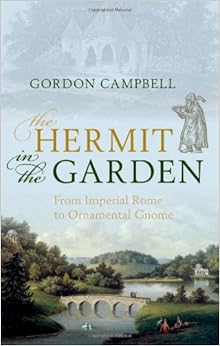
The Hermit in the Garden: From Imperial Rome to Ornamental Gnome

by Gordon Campbell, Oxford University Press, 2013
"In 1777 John Fuller, who is popularly but inaccurately known
as Mad Jack Fuller (he seems to have been wholly sane), inherited from his
uncle the family estate of Rose Hill, in Brightling (Sussex). After a tumultuous political career, in the
course of which he defended he living conditions of plantation slaves (he owned
a plantation in Jamaica) and was ejected from the House of Commons for
drunkenness, Fuller left parliament at the dissolution of 1812 and settled at
Rose Hill, where he had already embarked on the construction of a memorable set
of follies. He began with a Coadestone (i.e. ceramic) summer house with a ‘Tudor’
arch (restored in 1992) and went on to commission his own mausoleum (an 8-metre
high pyramid in Brightling churchyard), a rotunda garden temple, an obelisk
known as the Needle, a hermit’s tower and a building known as the Sugar Loaf
(an 11-metre cone which alludes to his sugar plantation).
The 8-metre hermit’s tower was built with a view to accommodating
an ornamental hermit, and Fuller is said to have advertised for a hermit with
the usual conditions of service. Here,
for example is the account in Follies: A National Trust Guide:
"The
requirements were a little excessive: no shaving, no washing, no
cutting
of hair and nails, no conversation with any outsider for a period
of
seven years, after which the happy hermit would be made a Gentleman.
No
takers.”
[No page numbers give in ebook version]
Monday, January 06, 2014
Did You Know? EAST SUSSEX A Miscellany

"The area around Brightling, east of Heathfield, is famous for a number of follies built in the early 19th century by John ‘Mad Jack’ Fuller (1757-1834), an eccentric local squire and ironmaster who lived a the Rose Hill estate, now Brightling Park. These include the Obelisk (or Brightling Needle) on Brightling Down, built to commemorate the Battle of Waterloo in 1815, and the cone-shaped Sugar Loaf (or Fuller’s Point) that stands in a field north of the B2056 just east of Woods Corner, south-west of Brightling, which Fuller is said to have built to win a bet. The story goes that he made a wager with a friend in London that he could see the spire of St Giles Church at Dallington from his house, but when he got home he found the view of the spire was blocked by a hill. Nothing daunted, in order to win the bet he had the Sugar Loaf folly built as a spire look-alike on high ground between his home and Dallington, which accurately resembled a distant view of the church’s distinctive spire when seen from his house. He was delighted with his ploy, and claimed that ‘no one can tell one from t’other’."
The authors do not provide any references so it is not known where either their assertion that the Obelisk was built in 1815 to commemorate the Battle of Waterloo or the quote attributed to Fuller originate.
Wednesday, November 01, 2006
Dallington “Six miles from everywhere”:
The history of a Sussex villageBy Karen Bryant-Mole 1999.
Chapter: Buildings of Interest
The Sugar Loaf, Pp 96-97
'This unusual building is situated next to the main Heathfield to Battle road, due east of the playing field. It is the only one of Jack Fuller’s follies to fall within the parish of Dallington. Jack Fuller was an M.P. in the first decade of the nineteenth century and was also the wealthy owner of Rose Hill (now Brightling Park) and its estate. He has been variously portrayed as eccentric, extravagant, benevolent and outspoken. One thing is for certain and that is that he enjoyed a good party.
The traditional tale of the Sugar Loaf is that during one such party he wagered that the spire of Dallington church could be seen from his home, Rose Hill. When he found that this was not so he ordered the conical building to be constructed, some say overnight, in order to fool his guests and win the bet. The exact date of its construction is not known but it is possibly around 1822. Jack Fuller later had the building converted into a labourer’s cottage. It is thought that Simeon Crouch and his family may have lived in the Sugar Loaf in the late 1870s, as family members have been told that one of his daughters, Mabel, was born there in 1879. Relatives of the Lulham family are believed to have been the last people to live in the Sugar Loaf. The stone building had two storeys, with windows on each floor. There was a ladder between the two floors and there was also a lean-to kitchen.
Local people recall that during the Second World War it was used as an anti-invasion machine gun post. Over the ensuing years, the abandoned building began to fall into disrepair. However a newspaper article of 1955 states that although ‘crumbling to a ruin’. The Sugar Loaf was ‘still a magnet to thousands of tourists every summer’.
The Sugar Loaf is situated on land that used to fro part of Christmas Farm. In the 1950s, Dennis Baker bought Christmas Farm form the Brightling Estate and in 1962 he donated the Sugar Loaf to the local council. '
Friday, October 27, 2006
Across Sussex With Belloc:
In the Footsteps of 'The Four Men'
By Bob Copper ISBN 07 509 06030

“At Oxley’s Green an isolated forge and blacksmith’s shop lies back from the road on the right-hand side and soon after, the sign of the inn situated at a crossroads tells us sustenance is at hand. it is the life-size figure of the gallant Jack Fuller himself, at one time squire of this parish, complete with top hat and umbrella, for this is the Fuller’s Arms, now called Jack Fuller’s , where Belloc and Grizzlebeard fell in with the Sailor..” pp 7
“The landlord greeted me at the door, a friendly man in a striped apron, which spike of close association with the kitchen. The inn is well over half a mile outside Brightling itself and was opened here, converted from an old barn, by the redoubtable Fuller to replace the one in the village. The public life of the Green \man in the village street, it appears, was terminated by the advocates of abstinence and piety because its proximity to the church opposite seemed adversely to affect the size of the Sunday congregations. Not a very subtle approach, it could be said, to this age-old problem, and none is left wondering if this somewhat costly and clumsy attempt to load the dice against the devil actually worked.” pp 8.
“On my first walk I had stuck to the original route and at Wood’s Corner had come out on the Heathfield road, which at the time was very quiet. I had also diverted and walked a couple of hundred yards east of the Swan Inn and taken a close look at the Sugar Loaf, a conical building some thirty feet high standing in a meadow with no obvious practical use. You can still visit it today. There is a door and several windows, all but one of which have been blocked up, and it is reputed to have been lived in by an old man who brought up his family there. It is also said that it was once the refugee of a hermit, but this must refer to a different incumbent and probably and earlier period. It would be quite impossible for one man to combine two such diverse roles, particularly with in such a confined space.” pp11
By Bob Copper ISBN 07 509 06030

“At Oxley’s Green an isolated forge and blacksmith’s shop lies back from the road on the right-hand side and soon after, the sign of the inn situated at a crossroads tells us sustenance is at hand. it is the life-size figure of the gallant Jack Fuller himself, at one time squire of this parish, complete with top hat and umbrella, for this is the Fuller’s Arms, now called Jack Fuller’s , where Belloc and Grizzlebeard fell in with the Sailor..” pp 7
“The landlord greeted me at the door, a friendly man in a striped apron, which spike of close association with the kitchen. The inn is well over half a mile outside Brightling itself and was opened here, converted from an old barn, by the redoubtable Fuller to replace the one in the village. The public life of the Green \man in the village street, it appears, was terminated by the advocates of abstinence and piety because its proximity to the church opposite seemed adversely to affect the size of the Sunday congregations. Not a very subtle approach, it could be said, to this age-old problem, and none is left wondering if this somewhat costly and clumsy attempt to load the dice against the devil actually worked.” pp 8.
“On my first walk I had stuck to the original route and at Wood’s Corner had come out on the Heathfield road, which at the time was very quiet. I had also diverted and walked a couple of hundred yards east of the Swan Inn and taken a close look at the Sugar Loaf, a conical building some thirty feet high standing in a meadow with no obvious practical use. You can still visit it today. There is a door and several windows, all but one of which have been blocked up, and it is reputed to have been lived in by an old man who brought up his family there. It is also said that it was once the refugee of a hermit, but this must refer to a different incumbent and probably and earlier period. It would be quite impossible for one man to combine two such diverse roles, particularly with in such a confined space.” pp11
Sunday, June 05, 2005
Bollocks to Alton Towers: The Sugar Loaf
"On a lighter note the Sugar Loaf was mentioned on national radio recently as it has been included in "B****cks To Alton Towers"! The book lists unusual and eccentric tourist attractions and the Sugar Loaf gets a mention along with the story of its creation. I haven't seen the book although the radio article was very accurate in what it said about the Sugar Loaf so I guess the authors have done their homework."
Publisher Penguin is marketing this guide book, written by Jason Hazeley, Robin Halstead, Joel Morris & Alex Morris, for those craving an alternative to the typical tourist trap holiday.
"Wouldn't it be better to go somewhere that everyone else hasn't - somewhere with something more interesting to say than 'have a nice day' or 'keep your hands inside the car while the ride is in motion'?
This is your chance. Turn away from the theme park queue and take a wayward tour of the backwaters and byways of the British tourist trail, celebrating the small, fascinating and unique."
£12.99 Hardback 135 x 216mm 256 pages ISBN 071814791X 28 Apr 2005
With thanks to Richard Groves
Publisher Penguin is marketing this guide book, written by Jason Hazeley, Robin Halstead, Joel Morris & Alex Morris, for those craving an alternative to the typical tourist trap holiday.
"Wouldn't it be better to go somewhere that everyone else hasn't - somewhere with something more interesting to say than 'have a nice day' or 'keep your hands inside the car while the ride is in motion'?
This is your chance. Turn away from the theme park queue and take a wayward tour of the backwaters and byways of the British tourist trail, celebrating the small, fascinating and unique."
£12.99 Hardback 135 x 216mm 256 pages ISBN 071814791X 28 Apr 2005
With thanks to Richard Groves
Saturday, February 10, 2001
Who was John "Mad Jack" Fuller?
The eccentric John Mad Jack Fuller, squire of Brightling, is a fascinating topic of research for me. Born in 1757 Fuller was in some ways a typical English squire and Member of Parliament in the Georgian Period. However, his penchant for building follies and his ebullient personality are the stuff of which legends are made. He was a patron of the arts and sciences who made valuable contributions to the community.
In 1777, at the age of 20, Jack Fuller inherited his family's wealth and mansion, Rose Hill at Brightling, East Sussex. He served 4 terms in parliament and was on more than one occasion removed from the House for raucous behaviour. Fuller was a huge man who wore his hair in a pig tail. He never married and had no children.
THE FOLLIES
He is buried in a 25 ft tall pyramid in the churchyard of St. Thomas of Canterbury church, a structure he had built 24 years before he died in 1834. Legend had it that he was interred in full evening dress, sitting upright at a table set with a roast chicken and a bottle of claret. Renovations to the pyramid in the 1980's put this tale to rest.
It is also said that when in London, Fuller bet that he could see the spire of Dallington church from his house. Upon returning home he found that this was not the case and sent a group of men out to erect a conical building designed to resemble the spire. Needless to say, Fuller won the bet and the Sugar Loaf as it has come to be called still stands.
Fuller's Observatory was furnished with state of the art astronomy equipment. It is now a private home. The Observatory, and quite possibly the Greek Rotunda Temple, was designed by noted architect Sir Robert Smirke who also designed the British Museum in London among other important commissions. The Obelisk or Brightling Needle, another of Fuller's legacies, is 65 ft high and is most likely a monument to celebrate Wellington's victory over Napoleon in 1815.
PHILANTHROPY
Among Fuller's lasting contributions to the community are: the Belle Tout lighthouse at Beachy Head and the barrel organ at Brightling church which is now the largest of its kind in full operation in Britain today. He is also credited with saving Bodiam castle from demolition as he purchased it from a firm of builders and had it restored. The Tower, another odd structure, is said to have been built by Fuller so that he could keep an eye on the progress of workmen at Bodiam. Fuller was a founding member of the Royal Institution and created two professorships which have endured into the 21st Century.
In 1777, at the age of 20, Jack Fuller inherited his family's wealth and mansion, Rose Hill at Brightling, East Sussex. He served 4 terms in parliament and was on more than one occasion removed from the House for raucous behaviour. Fuller was a huge man who wore his hair in a pig tail. He never married and had no children.
THE FOLLIES
He is buried in a 25 ft tall pyramid in the churchyard of St. Thomas of Canterbury church, a structure he had built 24 years before he died in 1834. Legend had it that he was interred in full evening dress, sitting upright at a table set with a roast chicken and a bottle of claret. Renovations to the pyramid in the 1980's put this tale to rest.
It is also said that when in London, Fuller bet that he could see the spire of Dallington church from his house. Upon returning home he found that this was not the case and sent a group of men out to erect a conical building designed to resemble the spire. Needless to say, Fuller won the bet and the Sugar Loaf as it has come to be called still stands.
Fuller's Observatory was furnished with state of the art astronomy equipment. It is now a private home. The Observatory, and quite possibly the Greek Rotunda Temple, was designed by noted architect Sir Robert Smirke who also designed the British Museum in London among other important commissions. The Obelisk or Brightling Needle, another of Fuller's legacies, is 65 ft high and is most likely a monument to celebrate Wellington's victory over Napoleon in 1815.
PHILANTHROPY
Among Fuller's lasting contributions to the community are: the Belle Tout lighthouse at Beachy Head and the barrel organ at Brightling church which is now the largest of its kind in full operation in Britain today. He is also credited with saving Bodiam castle from demolition as he purchased it from a firm of builders and had it restored. The Tower, another odd structure, is said to have been built by Fuller so that he could keep an eye on the progress of workmen at Bodiam. Fuller was a founding member of the Royal Institution and created two professorships which have endured into the 21st Century.
Labels:
Belle Tout,
Folly,
Obelisk,
Observatory,
Parliament,
Pyramid,
Royal Institution,
Smirke,
Sugar Loaf,
Temple,
Tower
Subscribe to:
Posts (Atom)