Showing posts with label Brightling. Show all posts

Monday, February 20, 2023

Brightling Church Postcard 1904


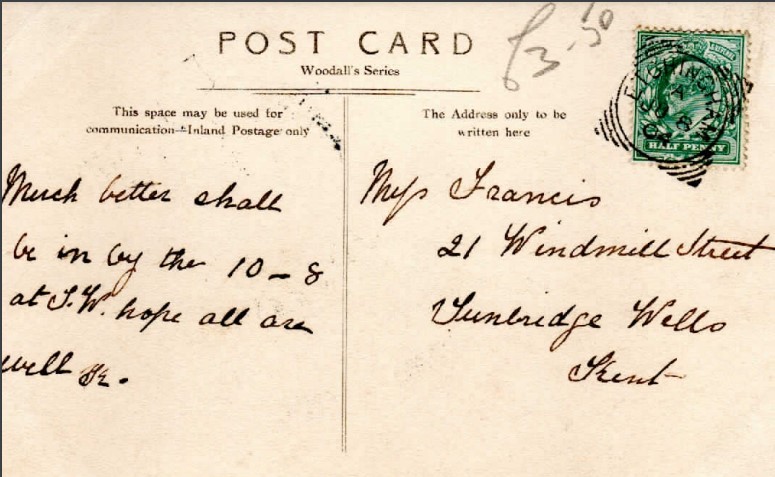
Postcards were a quick, inexpensive way of communication back in the days before everyone had a telephone. Sent from Etchingham on 8 June 1904, the message reads 'Much better shall be in by the 10-8 at T. W. hope all are well Gr.' I trust Mrs Francis of Windmill Street was glad to see them arrive by train. Mad Jack Fuller's pyramid mausoleum is seen to the left of Brightling Church.


Monday, August 30, 2021

The Mad Jack Walking Tour


Enjoy a walk, drive or cycle ride around the Sussex village of Brightling to see the intriguing follies built by John 'Mad Jack' Fuller. Download a pdf of the map and guide here. 


Saturday, July 06, 2019

Excursion: On the Trail of Mad Jack Fuller

NOT AFFILIATED WITH THIS BLOG OR ITS AUTHOR


Friday 2 August 2019 


Overview


John “Mad Jack” Fuller was an eccentric Georgian squire who built a number of follies in some of the highest and most attractive countryside in the South of England. Your guide for this fascinating day out will be Mark, who will introduce you to the life and times of this larger-than-life character, who became known as the “Squire of Brightling”. Our tour will take you to some of Fuller’s follies, including the Sugar Loaf and Brightling Needle, and ends at Brightling Church. Mad Jack lies buried in the churchyard in a bizarre 25-feet tall pyramid he had built 24 years before he died! There will be stops for refreshment (cost not included). To get the most out of the tour, a small amount of walking will be required so we recommend walking shoes.
Pick-up Points
LOCATION
TIME
Horsham (D&B)
08:10
Horsham (Station)
08:15
Horsham (Library)
08:20
Hop Oast (Park & Ride)
08:30
Southwater
08:35
Ashington
08:50
Storrington
09:00
Washington
09:10
Steyning
09:25

Saturday, June 08, 2019

Brightling Church Bells: What's in a Name?

Source: The Bell News and Ringers Record Vol III, 5/4/1884 - 28/3/1885, p 103

Fuller wished to celebrate the victories of the Duke of Wellington by gifting this peal of bells to home Brightling church. They are still rung regularly by the dedicated bellringers of the village.

The Battle of Salamanca was fought on 22 July 1812 in Spain; The Battle of the Pyrenees lasted from 25 July to 2 August 1813 on the Spain/France border, and Wellington's decisive victory over Napoleon took place at Waterloo in Belgium on the 18th of June 1815. 

Some of the spellings given here vary from those of the places where Wellington's battles occurred. Tallavera = Battle of Talavera, Spain (27-28 July 1809); Vittoria = Battle of Vitoria, Spain (21 June 1813);  and Orthes = Battle of Orthez, France (27 Feb 1814). I have not seen the actual inscriptions on the bells so I cannot confirm which spellings were used there. 

The 1979 Brightling Church Guide, written by Diana Boyd, mistakenly gives the name "Trattoria" instead of  "Tallavera".

Tuesday, January 01, 2019

Christmas at Rose Hill, Brightling

BRIGHTLING - JOHN MEAKIN

Christmas 1815


Christmas 1820


Christmas 1823


Christmas 1828


Christmas 1832


Sunday, June 28, 2015

SOME SUSSEX "FOLLIES" by William A. Bagley

"As usual, Sussex can claim its share of interesting things, and when it comes to "Follies," our county possesses some that are unique. The most compact group of these curiosities are those in the neighbourhood of Brightling and Dallington, the work of Squire "Jack" Fuller who made a hobby of erecting these "megalithic" monuments on his native heaths and hills.  He was a real "character" with a will of his own.  He succeeded to a great fortune at an early age, and there is no little doubt that lack of parental control lead to his subsequent eccentricities.  He represented the County in Parliament from 1801-1812, was reprimanded for insulting the Speaker, and refused a peerage, rather than desert his party.  He had two hobbies, music and science, and was a patron of literature.  It was he who saved Bodiam Castle from demolition and he who encouraged Turner, the artist. He liked to be known as "Honest Jack," but apparently did not rely on the honesty of others.  His progress from London to Brightling was almost regal.  The coachmen and footmen were armed with pistols and swords, and the coach provisioned as if for an expedition into the wilds.

Altogether a most interesting man, and one whose story was related in a early number of the S.C.M. [Sussex County Magazine], but how many would take the trouble to look up his record were it not for the constant reminder afforded by some of the strange monuments he erected?

On Brightling Down, 646 ft. high, stands an obelisk known as the "Needle," built on the site of an old beacon which blazed its warning of the coming of the Armada, and later, prepared to warn Sussex of the coming of Napoleon.  From this Needle--a great landmark--a superb panorama interrupted only by woods on the S.E. is obtained.  At Dallington, nearby, is a conical, two storied building known as the "Sugar Loaf."  The Observatory, built from the designs of Sir Robert Smirke, stands on Brightling Down.  This same architect designed the ugly pyramid, Fuller's mausoleum, in Brightling churchyard.

Curious tales are told of "Jack" Fuller.  It is said that he sought for a hermit to occupy the mausoleum for one year, during which he was not to shave, wash cut his hair, or hold any intercourse with the outer world.  After this ordeal, he was to be made a gentleman for life.  There were no offers!

It is also said when he was laid to rest in his strange tomb--in 1834, aged 77--he was placed, by desire, in an iron chair, with broken glass strewn all around.  He feared that the Devil would come to claim his own, and in doing so, would cut his hooves on the glass!

Both of the two foregoing stories are, in all probability, just idle legends engendered by the eccentric habits of the Squire.  In many respects, his foibles were exaggerated.  Take for example the massive miles-long wall surrounding his estate (Rose Hill: named after his wife)*. Not many tourists, who come in motor-coaches in the summer, notice this.  Those who do may think it another of his "follies".  One is not so sure.  Like other Grand Old English Gentlemen, Jack had more than his share of poor men at the gate, some of whom professed to be out-of-work masons and labourers.  Rather than give them his charity, he created this artificial job.  The more the beggars came, so did the wall grow, until it reached the proportions seen to-day."

SOME SUSSEX "FOLLIES" by William A. Bagley, Sussex County Magazine, Volume 11, March 1937, Number 3, pp 171- 176.

* Note: John "Mad Jack" Fuller 1757-1834 never married. The Rose Hill estate in Brightling was named by his grandfather, John Fuller 1680-1745 for his wife Elizabeth Rose, Mad Jack's grandmother.

Other Sussex follies mentioned in this article:

i. Holmbush Beacon Tower, at Colgate in St Leonard's Forest
ii. Racton Monument, Rowlands Castle Station
iii. Gibraltar Tower, Heathfield Park
iv. Toat Monument, near Pulborough
v. A gateway at Nore, Hill, Slindon
vi. Castelated Tower, at Michelgrove near Patching
vii. Firle Tower, West Firle
viii. Signaling Tower, Selsfield Common, near Turner's Hill
ix. Pepper Box, in Queen's Park, Brighton
x. Tower at Shillinglee Park, near North Chapel

Sunday, March 22, 2015

FUNERAL OF THE LATE JOHN FULLER ESQ.

On Saturday last, the remains of this lamented gentleman were conveyed to the tomb, at Brightling, in this county.  Precisely at two o'clock the procession arrived at the church, and presented one of the most imposing spectacles ever witnessed in that part of the country. The melancholy procession was preceded by a number of girls, dressed in dark coloured frocks, with broad white collars, these were followed by boys, habited in white round frocks, black crape hatbands and gloves -- next came about 66 men (workmen, we believe, on the estate of the deceased) clothed in new white round frocks, crape hatbands and black gloves -- after these were about 100 mounted horsemen, in black cloaks and silk hatbands -- plume of feathers, mutes &c.  The hearse, drawn by six horses, hung with silk escutcheons of the family arms -- the carriage of the deceased with the blinds closed drawn by six horses -- three or four mourning coaches -- followed by a number of gentlemen's carriages.  As soon as the procession arrived at the church gate, those who preceded the hearse formed an avenue to the church, through which the body was borne by eight men; the coffin was covered with a most superb pall, decorated with silk escutcheons.  Immediately the body entered the church yard, the fine organ (gift of the deceased), commenced a solemn dirge, and the usual service was performed; the body was then removed to the place destined for its reception, a large high pyramid, similar, but in miniature, to those of Egypt.  The day being fine, a vast number of sorrowing well dressed persons, of both sexes, amounting to 5,000 were present on the melancholy occasion.

THE SUSSEX ADVERTISER 21 April 1834, page 3

Saturday, March 07, 2015

Georgian Garden Buildings by Sarah Rutherford with Jonathan Lovie

Shire Publications, 2012

This lavishly illustrated book is a super reference guide to Georgian landscape garden buildings. It is organized into chapters on various structural forms from arches to grottoes to temples and towers.

John Fuller’s Brightling follies and other buildings are not mentioned but it is easy to map out into which chapters they would appear.


Chapter
Fuller’s Building
Columns
Gates
Mausolea and Monuments
Obelisks
Rotundas
Temples and Pavilions
Towers

The suggestion that Fuller advertised for a hermit to live in the tower seems to have been made long after the fact, so I would not include the tower in the “Hermitages and Root Houses” chapter.

The Sugar Loaf, on the other hand, is not so easy to categorize. Legend has it that Fuller had this cone-shaped folly built to win a wager that he could see the spire of St. Giles, Dallington from his home, Rose Hill.

Friday, February 13, 2015

Brightling Observatory For Sale in 1953

Sussex Express & County Herald, Friday October 16 1953 - Page 10

Brightling Observatory Is For Sale

Brightling Observatory, built by "Mad Jack" Fuller over 140 years ago, is for sale again.  It was built on the site of a beacon by Fuller, who was the Squire of Brightling, and a Sussex M.P. from 1801 to 1812.
Some time ago it was sold to the Gypsum Mines by the Squire, Mr. T.P. Tew, and later resold and redecorated for the use as a private residence.  It was recently bought by Mr. Grinling of Fair Court, Wadhurst.
The Observatory is almost s well known as the celebrated Brightling Needle nearby, which also owes its origin to Fuller, who died in 1834.
It stands, as if in answer to Fuller's Sugar Loaf "Folly" as testimony to the deeper side of Fuller's character as a cultivated gentleman and a patron of science.
Designed by the great architect Sir Robert Smirke, who built the British Museum, the observatory was erected in 1810, being intended by Fuller for the use of he eminent astronomer, Herschel whose bust could be seen inside the building for many years.
The astronomical instruments were removed about 1908, and the building used as a reading room and later converted into a cottage.

Brighting Observatory Sale

The Sussex Express and South Eastern Advertiser
Friday, May 23, 1919 - Page 1

Thursday, May 29th, 1919
THE OBSERVATORY, BRIGHTLING, 
MESSERS, 
E. WATSON & SON

Have received instructions from the Owner (who is giving up housekeeping), to SELL BY AUCTION on the premises as above:-- Brass and iron French bedsteads, feather beds, mattresses, mahogany-frame marble-top and other washstands, mahogany and painted chests of drawers, mahogany wardrobe, toilet tables and glasses, toilet ware, deal linen chest, mahogany dining table, deal-top dining table and other ditto, writing table, mahogany-frame dining chairs in leather, spring-seated easy and other chairs, sofas, china cabinet, Windsor chairs, pier glasses, pictures, fenders and fire irons, patent mangle, wash tubs, quantity of earthen and glass ware, a useful assemblage of domestic and culinary utensils, quantity of gardening tools, etc.
Sale to commence at 1.30 p.m.
No Catalogues.  Auction and Estate Offices, Heathfield (Phone No. 11).

Sunday, February 01, 2015

ARCHITECTURAL ODDITIES

Curious Buildings Upon Which an Englishman Spent His Money

New York Sun, Sunday January 2, 1910 – Page 8  From the London Daily News

The village of Brightling (about nine miles inland from Hastings) possesses probably the most novel collection of strange buildings in England.
About half a century ago a certain Squire Fuller, the chief resident; who was possessed of great riches, spent money lavishly on the erection of numerous quaint buildings with the idea of rendering his memory imperishable in the little village. Squire Fuller’s eccentricity earned him the sobriquet of “Mad Jack”.
Perhaps the most remarkable of the buildings is the Sugar Loaf House, in which the “Mad Squire” was anxious to immure a man for seven years –during which time the victim was neither to shave, wash or hold any communication with the outer world.  His food was to be passed in through a window. there were several candidates for the experiment, but he authorities intervened and forbade the execution of the wild scheme.
The observatory contains in the dome a camera obscura, which the Square place there so that his tenants could keep observation on their cattle without going into the fields.
Cleopatra’s Needle, built of local sandstone, stands at an altitude of 800 feet above the sea and its base is covered with innumerable visitors’ names.
Solomon’s Temple, built in the style of an Eastern mosque, with massive marble pillars, was used by “Mad Jack” as a card room
The Squire’s tomb, built to resemble the Pyramids, has a beautifully decorated interior and bears carved quotations from the Squire’s favorite authors.  The Squire’s coffin was placed on a stone trestle above ground and the door of the tomb locked with a key which was afterward destroyed.
Beacon Tower was originally intended to guide ships into Pevensey Bay, but the squire planted trees all round and this rendered it useless to mariners.

Notes:


  • There was at one time a camera obscura in the Brightling Observatory but it is doubtful that its purpose was for farmers to watch their cattle. 
  • Obelisks erroneously called "Cleopatra's Needles" are in Washington DC, Paris, London and Luxor. Jack Fuller built the Brightling Needle. 
  • The Rotunda Temple at Rosehill, now called Brightling Park, is not in the style of an Eastern mosque. It is a folly built in the neo-classical style.
  • Fuller's coffin was not placed on a stone trestle, he is buried in the conventional manner under the floor of his pyramid mausoleum
  • The "Beacon Tower" is too far inland to have been used to guide ships.

SQUIRE’S MEMORIAL TO HIMSELF

Brooklyn New York Daily Eagle – Tuesday February 2, 1909

[Photo Captions:  The Squire’s Tomb, Cleopatra’s Needle, Sugar Loaf House, Memorial to Squire Fuller, Solomon’s Temple]


In the British village of Brightling are a lot of strange buildings designed by a squire named Fuller, but better known as Mad Jack.  These were constructed to act in perpetuity as memorials to him.  In a sugar-loaf house the squire wished to inure a man for seven years on the understanding that during that time the prisoner was not to shave, wash or cut his hair, or hold communication with the outer world. Food was to be passed in through a small, boarded window. By way of reward, the squire proposed to make the man a “gentleman for life.” The scheme was vetoed by the authorities.  The interior of the squire’s tomb is finely decorated and bear inscriptions from his favorite authors.  The coffin is above ground on a stone trestle and the key to the tomb has been destroyed.  

Notes:
  • Captions: Fuller's pyramid mausoleum; Brightling Needle or Obelisk; Sugar Loaf Folly, Brightling Observatory, Rotunda Temple.
  • Fuller is buried beneath the floor of the pyramid. The interior is plain with only the ninth verse of Grey's elegy inscribed in the wall: 
'The boast of heraldry, the pomp of pow'r

And all that beauty, all that wealth e'er gave
Await alike th' inevitable hour
The paths of glory lead but to the grave'
  • The Sugar Loaf Folly was at one time occupied as a house. There are also unsubstantiated stories of Fuller advertising for a hermit to live in the mausoleum that he built 23 years before his death.


Friday, January 23, 2015

Jesse Gregson Charity

Jack Fuller did much to help relieve poverty in Brightling. Another means of assistance was the distribution of bread to those in need on Sundays by a charity founded by Brightling born Jesse Gregson.

"Another quaint custom connected with the church, is the giving of charity bread.  This charity was instituted for the benefit of the seven poorest people of Brightling with the largest families, each family receiving a loaf of bread from the church vestry at the conclusion of the Sunday services. The donor was a Mr. Jesse Gregson of Moor House in the parish of Hawkhurst, one of the Deputy-Lieutenants for the county of Kent.  He died in 1821.  Almost five years ago the distribution was transferred from the church to a neighbouring shop."  - The Sussex Agricultural Express October 18, 1929 – Page 12.


31st August 1825 - Extract of the Will of the late Jesse Gregson Esq Interest of 180 £ for Bread for the Poor of Brightling
Bequest was 200
Deduct Duty   20
                  £ 180

Gregson's Charity
"I give to the Rector and the Churchwardens and Overseers for the time being of the Poor of the Parish of Brightling aforesaid, where I was born the sum of two hundred pounds to be invested by them at Interest or in or upon any of the Government or Parliamentary Stocks or Funds of Great Britain or upon real Security in either of the said Counties of Sussex or Kent And I direct that the Interest thereof shall form time to tome for ever be laid out in the purchase of Bread to be distributed every Sunday to and among poor persons of the said last mentioned Parish who shall not receive alms or Parish Relief as the Rector or Minister Churchwardens and Overseers thereof for the time being shall think Proper.

J.B. Hayley, Rector"

The Jesse Gregson Charity still exists today and "makes grants to individuals".

[With thanks to Nicola Courtney Bennett]

Brightling's Barrel Organ: Quaint Feature of Historical Church

The Sussex Agricultural Express October 18, 1929 – Page 12

Mr. Henry Croft how has turned the organ every Sunday for 42 years.

The quaint old parish church of St. Thomas A Beckett at Brightling, is one of the most interesting country churches in the county.  Over 900 years old, it has undergone many alterations through the ages but there still exist traces of the very early work, including a fine Norman doorway, to which about the 17th century porch was added.  Part of the west and south wall still remain, and in the latter are the remains of an ancient water stoup.
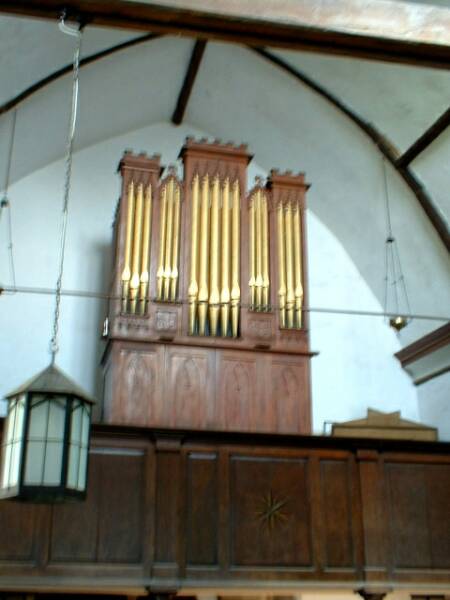
Across the west end of the nave there extends a fine gallery, erected about 1750, which is approached by a winding stairway.  The feature of the gallery is a barrel and wind organ which was given to the church by Mr. John Fuller about 1810.  It is believed there is only one other like it in the country, and that is at Windsor.  This unique instrument contains two barrels and a few pipes each barrel containing twelve tunes.  One consists of hymns for Lent, Easter and Christmas, with a few general hymn tunes, and the other double chants, psalms and voluntaries. 
The organist with his right hand turns a crank handle to revolve the barrels, with a foot pedal he supplies the air to the bellows and with his left hand he manipulates a set of six expression stops, the various tunes being changed by means of a slide.
The organ has been in use for over a century and is still sending forth its melodious tones at the Sunday services.  For forty years Mr. James Croft was the organist, and just before his death he was succeeded by his son, Mr. Henry Croft.  This interesting old gentleman was born on February 4th 1859  at Snail Farm, where he has lived all his life.  He was christened by the Rev. John Burrell Hayley, and was married in 1881 by the Rev. Thomas Burrell Hayley.  He has been connected with the church since he was twelve years old, when he was a choir boy.  He recalls the time when Robert Stapley, Henry Winchester and John Dale led the singing, using a tuning fork to give the keynote.  Then came the first musical accompaniment about 50 years ago, provided by six or seven fiddlers.  After that came the harmonium, then the American organ, which was used til about ten years ago, when a small modern pipe organ was placed in the chancel, which is used for the services to-day.  But all this time the barrel organ was used and was doing duty.  Every Sunday for 42 years Mr. Croft has played the voluntaries at the commencement and conclusion of services and the special festival hymns.
Another quaint custom connected with the church, is the giving of charity bread.  This charity was instituted for the benefit of the seven poorest people of Brightling with the largest families, each family receiving a loaf of bread from the church vestry at the conclusion of the Sunday services. The donor was a Mr. Jesse Gregson of Moor House in the parish of Hawkhurst, one of the Deputy-Lieutenants for the county of Kent.  He died in 1821.  Almost five years ago the distribution was transferred from the church to a neighbouring shop.

In the tower there is a fine peal of eight bells and in the churchyard is a huge pyramidal tomb, in which the donor of the barrel organ was buried.  

Saturday, January 03, 2015

Three time organ donor?

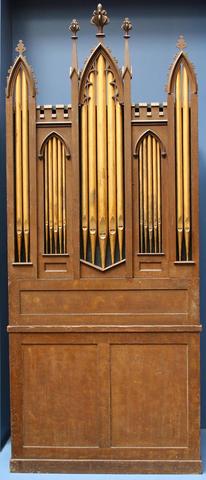
Looking at the timeline, one can't help question why John Fuller would purchase three barrel organs within a five year period. Where is/was the Flight & Robson organ? Did Fuller take delivery of it or was the purchase cancelled? Was it used in Brightling church or elsewhere? It is certain that the Nicholls' barrel organ, thought to be the largest of its type still operational in the UK, replaced an earlier instrument. What is not clear is whether there were one or two previous barrel organs purchase by Fuller and who made them.

DATE
EVENT
C. 1750
Gallery erected in Brightling Church[1]
1777
John “Mad Jack” Fuller inherits Rosehill, Brightling, Sussex after the death of his uncle Rose Fuller.
30 Aug 1815
Performance given by Samuel Wesley on the organ Fuller ordered from Flight and Robson at their manufactory at 101 St. Martin’s Lane, London[2]
12 Sept 1815
Samuel Wesley writes to William Shield, “I have been informed by Flight & Robson that Mr. Fuller came one Day from the Country, for the express Purpose of hearing the Music I prepared for his Organ, & although the Barrel had not been corrected for he was there before I had heard a Note of it myself) he manifested the most unequivocal Signs of perfect Approbation. …He was partly expected to come & hear the Organ on the Day that several Professional Men were invited: the Meeting was afterwards noticed and described in the News Papers very soon afterward” [3]
C. 1818
Alexander Buckingham (c1777-1853) establishes his own barrel and chamber organ firm at 39 Frederick Place, Hampstead Road, London. He is commissioned to build a barrel organ, (later known as the Williams Organ ) for Brightling Church around this time.(?) [4] 
C. 1820
Fuller commissions William Alfred. A. Nicholls of 9 Stephen Street, Tottenham Court Road, London, to build a larger barrel organ for Brightling Church[5]
15 March 1821
W.A.A. Nicholls is bankrupt.[6]
1829
Williams Organ shipped to Archdeacon Henry Williams and his brother William Williams when they were stationed as missioners at Paiha, Bay of Islands, New Zealand as a bequest from their Uncle John Marsh. It was the first barrel organ in New Zealand. [7]
April 1851
Williams organ installed in Holy Trinity Church at Pakaraka, Northland, New Zealand, which was a new church founded by Henry Williams [8]
1867
Edward Marsh Williams inherits the Williams Organ from his father, Henry Williams. [9]
1898
Rev. Alfred Owen Williams lends the Williams Organ to the Wanganui Museum, which he co-founded. The Williams Organ is restored to playing condition. [10]
1923
Nicholls’ Organ repaired by Aubrey Allen[11]
1927
Williams Organ repaired by Raynor White[12]
1960
Nicholls’ Organ repaired by Harrison and Harrison of Durham[13]
1964
Harrison and Harrison, of Durham restore the Nicholls’ Organ[14]
1966
Zillah and Robert Castle renovate the Williams Organ. [15]
1977
Nicholls’ Organ surveyed by the British Institute of Organ Studies[16]
1999
Nicholls’ Organ restored by Dominic Gwynn for Martin Goetze and Dominic Gwynn of Worksop, Nottinghamshire[17]
1999
Nicholls' Organ awarded Historic Organs Certificate (Ungraded) [18]


[1] French, Brian A., Brightling: Parish Church of St. Thomas à Becket, 1972, p. 5
[2] Morning Post, September 01, 1815 - Page 3
[3] Olleson, Phillip, The Letters of Samuel Wesley: Professional and Society Correspondence, 1797-1837,.pp. 248-9, Doctoral Thesis, OUP, 2001
[4] http://en.wikipedia.org/wiki/Alexander_Buckingham
[5] Boyd, Diana, Brightling Church Guide, Tea Brokers’ Publications Limited, 1979, p. 18
[6] Caledonian Mercury, March 15, 1821 – Page 2
[7] http://collection.wrm.org.nz/search.do?id=1171&db=object&page=1&view=detail
[8] Ibid
[9] Ibid
[10] Holman, Anne, Of “Bruite beasts and Horses’ legs”: The Brightling Church barrel organs and country church music, S & P Printers, 2000, p.13
[11] Ibid, p. 21
[12] Ibid, p. 13
[13] http://www.npor.org.uk/NPORView.html?RI=N15468
[14] Ibid
[15] Holman, p 13
[16] http://www.npor.org.uk/NPORView.html?RI=N15468
[17] Holman, p. 14
[18] Holman, p 22


Record ImageLeft: Nicholls' Barrel Organ in the gallery at Brightling Church
Right: Williams Barrel Organ in the Wanganui Regional Museum, New Zealand                                                                                  


Sunday, March 02, 2014

Watercolour of Rosehill by S.H. Grimm 1784

John Fuller's House At Rose Hill In Brig A north-east watercolour view of 'Mr Fullers house at Rosehill' (Rose Hill, in Brightling) in (East) Sussex, drawn in 1784 by S.H. Grimm. Source: British Library. Samuel Hieronymus Grimm was born in Burgdorf, Switzerland on 18 January 1733. He worked in oils until 1764 and chiefly in watercolour and pen and ink after that. Under the patronage of the Rev Sir Richard Kaye, Grimm travelled widely in England recording the landscape between 1768 and his death in 1794. The British Library has some 886 of his drawings of Sussex and 2662 works altogether.

Monday, January 06, 2014

Did You Know? EAST SUSSEX A Miscellany


51xLXXSEFlL._SL500_AA300_.jpg (300×300)
Compiled by Julia Skinner, page 44 

"The area around Brightling, east of Heathfield, is famous for a number of follies built in the early 19th century by John ‘Mad Jack’ Fuller (1757-1834), an eccentric local squire and ironmaster who lived a the Rose Hill estate, now Brightling Park. These include the Obelisk (or Brightling Needle) on Brightling Down, built to commemorate the Battle of Waterloo in 1815, and the cone-shaped Sugar Loaf (or Fuller’s Point) that stands in a field north of the B2056 just east of Woods Corner, south-west of Brightling, which Fuller is said to have built to win a bet. The story goes that he made a wager with a friend in London that he could see the spire of St Giles Church at Dallington from his house, but when he got home he found the view of the spire was blocked by a hill. Nothing daunted, in order to win the bet he had the Sugar Loaf folly built as a spire look-alike on high ground between his home and Dallington, which accurately resembled a distant view of the church’s distinctive spire when seen from his house. He was delighted with his ploy, and claimed that ‘no one can tell one from t’other’."

The authors do not provide any references so it is not known where either their assertion that the Obelisk was built in 1815 to commemorate the Battle of Waterloo or the quote attributed to Fuller originate.