Showing posts with label Pyramid. Show all posts

Monday, February 20, 2023

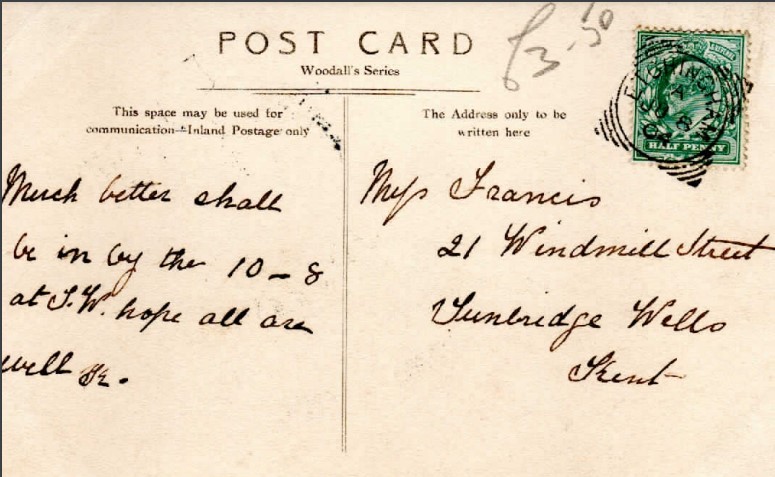
Brightling Church Postcard 1904


Postcards were a quick, inexpensive way of communication back in the days before everyone had a telephone. Sent from Etchingham on 8 June 1904, the message reads 'Much better shall be in by the 10-8 at T. W. hope all are well Gr.' I trust Mrs Francis of Windmill Street was glad to see them arrive by train. Mad Jack Fuller's pyramid mausoleum is seen to the left of Brightling Church.


Monday, August 30, 2021

The Mad Jack Walking Tour


Enjoy a walk, drive or cycle ride around the Sussex village of Brightling to see the intriguing follies built by John 'Mad Jack' Fuller. Download a pdf of the map and guide here. 


Sunday, June 28, 2015

SOME SUSSEX "FOLLIES" by William A. Bagley

"As usual, Sussex can claim its share of interesting things, and when it comes to "Follies," our county possesses some that are unique. The most compact group of these curiosities are those in the neighbourhood of Brightling and Dallington, the work of Squire "Jack" Fuller who made a hobby of erecting these "megalithic" monuments on his native heaths and hills.  He was a real "character" with a will of his own.  He succeeded to a great fortune at an early age, and there is no little doubt that lack of parental control lead to his subsequent eccentricities.  He represented the County in Parliament from 1801-1812, was reprimanded for insulting the Speaker, and refused a peerage, rather than desert his party.  He had two hobbies, music and science, and was a patron of literature.  It was he who saved Bodiam Castle from demolition and he who encouraged Turner, the artist. He liked to be known as "Honest Jack," but apparently did not rely on the honesty of others.  His progress from London to Brightling was almost regal.  The coachmen and footmen were armed with pistols and swords, and the coach provisioned as if for an expedition into the wilds.

Altogether a most interesting man, and one whose story was related in a early number of the S.C.M. [Sussex County Magazine], but how many would take the trouble to look up his record were it not for the constant reminder afforded by some of the strange monuments he erected?

On Brightling Down, 646 ft. high, stands an obelisk known as the "Needle," built on the site of an old beacon which blazed its warning of the coming of the Armada, and later, prepared to warn Sussex of the coming of Napoleon.  From this Needle--a great landmark--a superb panorama interrupted only by woods on the S.E. is obtained.  At Dallington, nearby, is a conical, two storied building known as the "Sugar Loaf."  The Observatory, built from the designs of Sir Robert Smirke, stands on Brightling Down.  This same architect designed the ugly pyramid, Fuller's mausoleum, in Brightling churchyard.

Curious tales are told of "Jack" Fuller.  It is said that he sought for a hermit to occupy the mausoleum for one year, during which he was not to shave, wash cut his hair, or hold any intercourse with the outer world.  After this ordeal, he was to be made a gentleman for life.  There were no offers!

It is also said when he was laid to rest in his strange tomb--in 1834, aged 77--he was placed, by desire, in an iron chair, with broken glass strewn all around.  He feared that the Devil would come to claim his own, and in doing so, would cut his hooves on the glass!

Both of the two foregoing stories are, in all probability, just idle legends engendered by the eccentric habits of the Squire.  In many respects, his foibles were exaggerated.  Take for example the massive miles-long wall surrounding his estate (Rose Hill: named after his wife)*. Not many tourists, who come in motor-coaches in the summer, notice this.  Those who do may think it another of his "follies".  One is not so sure.  Like other Grand Old English Gentlemen, Jack had more than his share of poor men at the gate, some of whom professed to be out-of-work masons and labourers.  Rather than give them his charity, he created this artificial job.  The more the beggars came, so did the wall grow, until it reached the proportions seen to-day."

SOME SUSSEX "FOLLIES" by William A. Bagley, Sussex County Magazine, Volume 11, March 1937, Number 3, pp 171- 176.

* Note: John "Mad Jack" Fuller 1757-1834 never married. The Rose Hill estate in Brightling was named by his grandfather, John Fuller 1680-1745 for his wife Elizabeth Rose, Mad Jack's grandmother.

Other Sussex follies mentioned in this article:

i. Holmbush Beacon Tower, at Colgate in St Leonard's Forest
ii. Racton Monument, Rowlands Castle Station
iii. Gibraltar Tower, Heathfield Park
iv. Toat Monument, near Pulborough
v. A gateway at Nore, Hill, Slindon
vi. Castelated Tower, at Michelgrove near Patching
vii. Firle Tower, West Firle
viii. Signaling Tower, Selsfield Common, near Turner's Hill
ix. Pepper Box, in Queen's Park, Brighton
x. Tower at Shillinglee Park, near North Chapel

Sunday, March 22, 2015

FUNERAL OF THE LATE JOHN FULLER ESQ.

On Saturday last, the remains of this lamented gentleman were conveyed to the tomb, at Brightling, in this county.  Precisely at two o'clock the procession arrived at the church, and presented one of the most imposing spectacles ever witnessed in that part of the country. The melancholy procession was preceded by a number of girls, dressed in dark coloured frocks, with broad white collars, these were followed by boys, habited in white round frocks, black crape hatbands and gloves -- next came about 66 men (workmen, we believe, on the estate of the deceased) clothed in new white round frocks, crape hatbands and black gloves -- after these were about 100 mounted horsemen, in black cloaks and silk hatbands -- plume of feathers, mutes &c.  The hearse, drawn by six horses, hung with silk escutcheons of the family arms -- the carriage of the deceased with the blinds closed drawn by six horses -- three or four mourning coaches -- followed by a number of gentlemen's carriages.  As soon as the procession arrived at the church gate, those who preceded the hearse formed an avenue to the church, through which the body was borne by eight men; the coffin was covered with a most superb pall, decorated with silk escutcheons.  Immediately the body entered the church yard, the fine organ (gift of the deceased), commenced a solemn dirge, and the usual service was performed; the body was then removed to the place destined for its reception, a large high pyramid, similar, but in miniature, to those of Egypt.  The day being fine, a vast number of sorrowing well dressed persons, of both sexes, amounting to 5,000 were present on the melancholy occasion.

THE SUSSEX ADVERTISER 21 April 1834, page 3

Saturday, January 24, 2015

Cobham Wood and the Darnley Mausoleum


John Bligh, the 3rd Earl of Darnley left detailed instructions in his will about the pyramid he wanted built on his estate at Cobham, Kent as a final resting place for himself and his family members. Designed by James Wyatt and built by George Dance Jr in 1783 the mausoleum was never consecrated and so no one is actually buried there.
It has endured a sordid past as the setting for porn films and black masses. Now restored and managed by the National Trust the mausoleum is open to the public on Sundays. Cobham Wood has been designated an "area of outstanding natural beauty and is open year round.

Wednesday, December 25, 2013

Up to a Point by David Winpenny

Order David Winpenny's Up to A Point
from his website 
here. 
In search of pyramids in Britain and Ireland

I highly recommend this comprehensive reference book, a mammoth undertaking, which includes historic pyramids as well as those built in recent years. Chock full of pictures and well researched text, I'm sure I'll return to it again and again.


On the two page spread about Mad Jack Fuller's mausoleum (68 & 69), Winpenny begins by wondering why Fuller's pyramid is so well known today, when so many others have faded into obscurity. He proposes that it may be because at 25 feet tall, it's hard to miss. He adds that it may be because Fuller had a number of follies built in and around his Rose Hill, Brightling estate, of which his pyramid mausoleum is only one. There are also the myths surrounding Fuller's pyramid: he's interred seated on a iron chair in a top hat in front of a table with a full dinner and bottle of wine, around him on the floor a circle of broken glass to keep the devil from claiming one of his own. When renovations were made in 1982 this was proved wrong but a stanza from Gray's Elegy in a Country Churchyard inscribed on an interior wall was revealed.

Perhaps the pyramid's notoriety is just part of the larger legacy left behind by a larger than life Georgian Squire - his parliamentary career; the Fullerian Professorships at the Royal Institution; Eastbourne Lifeboat; Belle Tout Lighthouse; JMW Turner's Views of Sussex and other works; Bodiam Castle; the bells and barrel organ at St Thomas à Beckett Church, Brightling; the Fuller family's Sussex landholdings, ironfounding at Heathfeild and sugar plantations in Jamaica.

Fuller's pyramid was completed on 15 June 1811 and Winpenny writes, "For the remaining 23 years of Fuller's life he could see it from the windows of Rose Hill", Winpenny, pg. 69. An interesting notion. I can't help but wonder if this is still the case. From the aerial view, seen below, it is plausible but it would depend on the height of the trees separating the churchyard and what is now known as Brightling Park.


Merry Christmas and Best Wishes for 2014


You can just make out the diagonal lines of John Fuller's snow covered pyramid mausoleum to the left of the church, tucked in behind the trees.

Saturday, June 22, 2013

Postcard 5: Fuller's Pyramid, Brightling Churchyard


Published by The R.A.P. Co. Ltd., London, E. C. 4

Saturday, June 15, 2013

Postcard 4: Brighling Church, Sussex

 
Hand coloured postcard shows Jack Fuller's pyramid mausoleum in the churchyard

 
Printed by A. H. Homewood, Burgess Hill
Postmarked Robertsbridge July 7 1906

Miss Butlers
Hilders Court
Chiddingly
Sussex


Dear E.
I think this a good Photo of
Brightling. We are
haveing it very
hot to day hope
you are well.
Yours Sincerely,
G T.

Tuesday, April 02, 2013

William Mackenzie's Pyramid, Church of Saint Andrew, Liverpool

In the churchyard of this Presbyterian church, closed since 1975, stands a pyramid mausoleum dedicated to William Mackenzie. He was born on the 20th of March in 1794 at Nelson, Lancashire and died on 29 October 1851 at his home at 74 Grove Street, Liverpool. Mackenzie was a civil engineer and contractor who worked on canals, tunnels and railways throughout the United Kingdom and parts of Europe.

Legend has it that Mackenzie was a gambler who had a wager with the devil and so asked to be interred seated upright holding a winning hand of cards so Satan couldn't claim his soul after his death.

This seems highly unlikely as the pyramid was commissioned by his younger brother, and sole heir, Edward, in 1868 which was seventeen years after his death. An inscription reads: "In the vault beneath lie the remains of William Mackenzie of Newbie, Dumfriesshire, Esquire who died 29th October 1851 aged 57 years. Also, Mary his wife, who died 19th December 1838 aged 48 years and Sarah, his second wife who died 9th December 1867 aged 60 years. This monument was erected by his Brother Edward as a token of love and affection A.D. 1868. The memory of the just is blessed". Source: http://en.wikipedia.org/wiki/William_Mackenzie_(contractor)

The day we visited was cold, overcast and light snow was falling. The church is under extensive renovations but I believe it has been decommissioned so more research is needed to find out about its future.

Friday, March 22, 2013

Postcard 3: John Fullers Tomb, Brightling Churchyard

Pub. by T. Croft, Hollingrove, Brightling - undated

Notice that the entrance is bricked up. Wondering when that was done and when the bricks were removed.


Tuesday, March 19, 2013

Did the Pyramid of Cestius inspire Fuller to build his mausoleum?

The Pyramid of Caius Cestius with the Aurelian Walls, Rome
Victor-Jean Nicolle (1754-1826)

The Pyramid of Caius Cestius with the Aurelian Walls, Rome

A page about St Thomas a Beckett Church, Brightling  on the Britain Express website states that Jack Fuller's pyramid mausoleum was modelled after the Tomb of Cestius in Rome. The illustration above, by Parisian artist Victor-Jean Nicolle was done during one of his trips to Rome of either 1787–89 or 1806–11. The Pyramid of Cestius dates to about 12 BC and is approximately 120 feet (36 m) high and made of brick and cement, faced with white marble. 
"The pyramid was an essential sight for many who undertook the Grand Tour in the 18th and 19th centuries. It was much admired by architects, becoming the primary model for pyramids built in the West during this period." Source: Wikipedia

File:Comparison of pyramids.svg

Saturday, March 16, 2013

Site Unseen The Pyramid, Brightling

This article, by Andrew John Davies, appeared in The Independent on Tuesday 12 December 1995. Davies likens actor Sir Robert Stephens, who died on 12 November 1995, to "those full-bodied and memorable individuals who live life to its utmost and devil take the consequences" .  Mad Jack Mytton, Lord Rokeby,  John Elwes and Mad Jack Fuller are offered as examples of larger than life characters. 

Of Fuller, Davies writes, "His house has an observatory which allowed the servants to peer through a telescope and spot the master returning home from London.". It seems he is confusing The Tower with the Observatory, neither of which are actually in Fuller's house Rose Hill.  He also states the the Obelisk or Brightling Needle was erected to "commemorate the defeat of Napoleon in 1815." Although one may conjecture that this is the case, there is scant evidence to support this claim. 

I wonder what Davies is referring to when he closes with, "Guide books are normally available inside the church". Does he mean the Brightling Church Guide by Diana Boyd?

Saturday, March 02, 2013

A Village's Queer Buildings by Frederick John

The Sussex County Magazine October 1928, No. 10 Vol. II, pages 442 - 443


John asserts that without John Fuller and the Needle, Brightling "would have achieved little fame". It would be an unremarkable Sussex village. He writes, " Every summer huge chars-a-bancs labour up from the coast resorts to the altitude of 646 feet, bringing their loads of curious trippers to gaze a the famous Needle, and to speculate vaguely on its origin and purpose." One can visualize these open topped vehicles, very popular in the 1920s, filled with holiday makers from Eastbourne or Hastings visiting Brightling on day outings.  

Interestingly, John refers to Fuller's buildings as "masonic enigmas". Pyramids and obelisks have long been considered symbols of freemasonry. This is not the first allusion that John Fuller was a mason that I've encountered. I have yet to find concrete evidence to support this notion, however. 

This article is illustrated with charming ink drawings of the observatory, Brightling Needle and "Mad Jack's" Mausoleum (above).  The name of the illustrator is difficult to read but the surname appears to be Boulter-Cooke. A writer and illustrator named Mabel Adeline Boulter-Cooke made contributions to The Sussex County Magazine around the same time. Could this be her work or that of a relative?


Sunday, September 18, 2011

Pyramid mausoleums and memorials


I recently watched an episode of Agatha Christie's Miss Marple called The Murder at the Vicarage, and noticed a pyramid in the churchyard. The Hampshire village of Nether Wallop doubled as St Mary Mead in this series and the churchyard is of St Andrews. The 15 ft high pyramid is the mausoleum of Francis Douce who died in 1760.
A GEOlocation.ws web page says, "[Francis Douce's] cousin built the pyramid at Farley Mount (26204) and another relative ("Mad" Jack Fuller) has a similar pyramidal mausoleum at Brightling (63951). "
The Horse Monument at Farley Mount Country Park was erected by Paulet St John in memory of a horse, named "Beware Chalk Pit", which carried its owner to a racing victory in 1734, a year after having fallen into a chalk pit whilst out fox-hunting".
I am currently trying to establish whether or not either Francis Douce and/or Paulet St John are related to John Fuller. Can anyone help?

Tuesday, January 31, 2006

Sussex follies and Mad Jack


Inside Out - BBC South East: Monday January 30, 2006
Inside Out looks at some unusual features on the Sussex landscape, and asks if their creator John Fuller was mad or just slightly eccentric?
A pyramid isn't what you'd normally expect to see in an English graveyard.
But this pyramid isn't in Egypt - it's in Brightling, East Sussex.
It's not the tomb of an Egyptian pharaoh, it's the tomb of a Georgian squire - Mad Jack Fuller.

The real Mad Jack

So who was the real Jack Fuller?
Born John Fuller in 1757, Mad Jack was MP for Lewes and incredibly rich.
He got his nickname from the way he spent his money, trying to make sure he was remembered.
Today he is remembered, as 'Mad' Jack.
But how mad was he? To find out, Inside Out has assembled a team of experts:
Keith Leech - member of Mad Jack's Morris Dancers.
Celia Caulkin - leads walks around Mad Jack's follies.
Geoff Hutchinson - he's written a book about Mad Jack.


Read the full article here. There are one or two minor inaccuracies.
Photo courtesy of Mark Duncan.

Thursday, January 26, 2006

Fuller's Pyramid


On Wednesday January 25, Tristan Forward published some excellent photos of Jack Fuller's pyramid and details of St Thomas Church, Brightling on his The Emotional Blackmailers Handbook blog which can be viewed here.

Tuesday, November 29, 2005

"History Hunger" & Perch Hill Farm


I have just finished Perch Hill: A New Life by Adam Nicolson.
I found myself rereading entire pages simply to savour Nicolson's descriptions of the High Weald. He writes regarding his curiousity about the history of the 90 acre farm and its previous tennants:
"The written documents run out too early and are no good anyway, a list of men and, from time to time the tax they paid. 1832: Edmund Goldsmith is the tenant of John Fuller, known to history as Mad Jack, a rabid Tory, Member of Parliament, sugar-and-iron millionaire, folly-building eccentric, patron of Turner, buried in Brightling churchyard in a pyramid where he is said, erroneously, to be sitting down to a final gargantuan dinner at a cast-iron table. That's what we know about Jack Fuller. We don't know anything about Edmund Goldsmith. "pp. 121

Photos by Wealden artist Paul Jackson, with kind permission.

Wednesday, December 29, 2004

Eccentric Britain: A celebration of Britain's bizarre buildings, peculiar places and offbeat events

By Des Hannigan, photography by Chris Coe

A fun and interesting look at what makes Britain unique and a wonderful tourist destination. The text however, does not live up to the standards of the photographs. The author's motto appears to be, "Never let the truth get in the way of a good story".

Fuller's Fabulous Follies, pp.61 -62
Brightling, Sussex

Corrections:

"Down on the Downs round Brightling" - Brightling is located on the High Weald which commands a pleasant view of the South Downs.

"Mad Jack was born in 1757 into a wealthy ironfounding family that made its fortune from slavetrading and producing guns for the British Navy " - The Fuller family certainly made money from its sugar plantations in Jamaica which were worked by slaves. But to say they were slave traders is stretching the point.

"Legend says that Jack's corpse was perched on an iron chair inside the tomb..." - This was discovered to be untrue during renovations in 1982. Fuller is indeed buried in the conventional manner beneath the pyramid as directed in his will.

"Never go anywhere on an empty stomach was Jack's motto." - John "Mad Jack" Fuller's motto was 'Utile nihil quod non henestrum' - Nothing is of use which is not honest.

"Before his friends woke up he sent his workers to erect the top of a false steeple out of stones and clay". - It is not possible that the Sugarloaf was erected in just a few hours.

Saturday, February 10, 2001

Who was John "Mad Jack" Fuller?

The eccentric John Mad Jack Fuller, squire of Brightling, is a fascinating topic of research for me. Born in 1757 Fuller was in some ways a typical English squire and Member of Parliament in the Georgian Period. However, his penchant for building follies and his ebullient personality are the stuff of which legends are made. He was a patron of the arts and sciences who made valuable contributions to the community.

In 1777, at the age of 20, Jack Fuller inherited his family's wealth and mansion, Rose Hill at Brightling, East Sussex. He served 4 terms in parliament and was on more than one occasion removed from the House for raucous behaviour. Fuller was a huge man who wore his hair in a pig tail. He never married and had no children.

THE FOLLIES

He is buried in a 25 ft tall pyramid in the churchyard of St. Thomas of Canterbury church, a structure he had built 24 years before he died in 1834. Legend had it that he was interred in full evening dress, sitting upright at a table set with a roast chicken and a bottle of claret. Renovations to the pyramid in the 1980's put this tale to rest.

It is also said that when in London, Fuller bet that he could see the spire of Dallington church from his house. Upon returning home he found that this was not the case and sent a group of men out to erect a conical building designed to resemble the spire. Needless to say, Fuller won the bet and the Sugar Loaf as it has come to be called still stands.

Fuller's Observatory was furnished with state of the art astronomy equipment. It is now a private home. The Observatory, and quite possibly the Greek Rotunda Temple, was designed by noted architect Sir Robert Smirke who also designed the British Museum in London among other important commissions. The Obelisk or Brightling Needle, another of Fuller's legacies, is 65 ft high and is most likely a monument to celebrate Wellington's victory over Napoleon in 1815.

PHILANTHROPY


Among Fuller's lasting contributions to the community are: the Belle Tout lighthouse at Beachy Head and the barrel organ at Brightling church which is now the largest of its kind in full operation in Britain today. He is also credited with saving Bodiam castle from demolition as he purchased it from a firm of builders and had it restored. The Tower, another odd structure, is said to have been built by Fuller so that he could keep an eye on the progress of workmen at Bodiam. Fuller was a founding member of the Royal Institution and created two professorships which have endured into the 21st Century.