Showing posts with label Heathfield. Show all posts

Wednesday, July 17, 2013

Fuller Furnace II

Heathfield Park: A private estate and a Wealden town
By Roy Pryce (Author’s Publishing Guild, Hadlow Down, East Sussex; 1996)


Major John Fuller of the Trained Bands bought Bayley Park from Frances Turvin in what would be called in modern terms a distress sale for £900 in 1708. It is not known who lived in the house during the Fuller’s ownership which lasted 13 years.  Tanners Manor at Waldron was home to the Fullers until John’s brother Thomas rebuilt the mansion at Brightling. It was renamed Rose Hill in 1705 by Thomas’ son, another John Fuller in honour of his wife, Jamaican sugar plantation heiress,  Elizabeth Rose.
When Major Fuller sold Bayley Park in 1721 for £2400 it was only a slightly smaller estate of 227 acres.  “But Fuller still contrived to safeguard the all-important rights to its water in a covenant under which he reserved the liberty to draw water from the several ponds belonging to the premise ‘as high as and including the Banqueting House pond’ for the use of his furnaces as long as the level did not go lower than ‘the sluices laid for that purpose’.  ESRO SAS RF 3/95; page 45.

Page 44
“Bayley Park  [now Heathfield Park] occupied a strategic position up-stream from the Furnace where a number of springs were located and where water could be collected in holding (’pen’) ponds ready for use when needed. Although it is not known precisely when those in the Park were constructed, it is almost certainly at this time: William Figg’s map of 1819 shows five of them.  According to one account they formed part of a continuing chain three miles in length containing eleven ponds in all. Even so they were not sufficient to enable the furnace to function throughout the year: its operations were largely confined to the winter months, and sometimes had to be curtailed as early as April.” 

Sunday, July 07, 2013

Fuller Furnace I

Hammer and Furnace Ponds: Relics of the Wealden Iron Industry
 An introduction and guide 

By Helen Pearce (Pomegranate Press, Lewes, East Sussex; 2011)
This well researched book provides a concise history of Wealden Iron Industry and a gazetteer of hammer and furnace ponds in East & West Sussex, Kent and Surrey.  Included is a list of museums with relevant artifacts in their collections. It mentions a Fuller falconet or small cannon at the Tunbridge Wells Museum which is currently closed for renovations.
An abbreviated version of the book can be read at Helen Pearce’s website here: http://www.hammerpond.org.uk/index.htm . The site is periodically updated with revised and new information.

Page 76

Heathfield
TQ 594196
Ex 123 (Ordnance Survey Explorer Map)
Private Property – no access

John Fuller of Brightling built Heathfield Furnace in 1693. He was a primary ordnance supplier to Ireland, Sardinia and Naples as well as the British government: two of his guns stand by the Tower of London.  The ironworks ceased production in 1793.  The furnace pond was near the hamlet of Old Heathfield, but has since been drained and the bay damaged.  A chain of four pen ponds survives upstream within the private Heathfield Park.  Originally there were twelve according to a 1795 estate map. (Cleere & Crossley, 1995: 335), presumably necessary due to local watershed difficulties.
Another small pen pond survives together with part of the old brick spillway at TQ 594196, down a muddy public footpath. Old Heathfield can be reached by travelling west along the B2069 road, turning right down School Hill just before Cade Street . John Fuller’s great-grandson was the infamous ‘Mad Jack’ Fuller, who built several follies around the Brightling area.


Fuller one-pounder at Anne of Cleves Museum, Lewes.

Thursday, June 06, 2013

The Landscapes of East Sussex by David Sellman & Rupert Taylor

Published by Countryside Books (Nov 10 2000)

In the chapter called Commanding the Rother a description of Bodiam Castle mentions John "Mad Jack" Fuller and his ownership of this much photographed landmark:

"But the arrow slits, cannon ports and 'murder holes' (through which missiles could be dropped through the cieling on attackers) were never used in anger.  The castle fell into decay and was rescued in 1829 by 'Mad Jack' Fuller of Brightling when a Hastings builder planned to demolish it, and was then restored by two later owners, George Cubitt and Lord Curzon who presented it to the nation.  Under the care of the National Trust is is now a breathtaking if incongruous part of the landscape. The moat is fed by springs and the water is certainly purer now than in medieval times - there are no fewer than 28 garderobes or latrines at Bodiam, each with a drain shaft to the moat. "

There is an error in the section about Heathfield Park in which the authors confuse a noted local diarist with a famed landscape painter:

"The view south they may or may not have noticed. But it has barely changed since Thomas Turner painted The Vale of Heathfield two centuries ago."

Thomas Turner (1729 -1793) was a shopkeeper in East Hoathly, Sussex whose eleven year diary makes interesting reading and provides insight into life in an Eighteenth Century village. Joseph Mallord William Turner (1775-1851) was commissioned by Jack Fuller to paint views of Sussex, which included The Vale of Heathfield (1815), The Vale of Ashburnham, Brightling Observatory from Rosehill Park, The Vale of Pevensey and Battle Abbey, the Spot Where Harold Fell. 


The Vale of Heathfield - 1815
The Vale of Heathfield by JMW Turner

Wednesday, November 01, 2006

Dallington “Six miles from everywhere”:

The history of a Sussex village
By Karen Bryant-Mole 1999.

Chapter: Buildings of Interest
The Sugar Loaf, Pp 96-97

'This unusual building is situated next to the main Heathfield to Battle road, due east of the playing field. It is the only one of Jack Fuller’s follies to fall within the parish of Dallington. Jack Fuller was an M.P. in the first decade of the nineteenth century and was also the wealthy owner of Rose Hill (now Brightling Park) and its estate. He has been variously portrayed as eccentric, extravagant, benevolent and outspoken. One thing is for certain and that is that he enjoyed a good party.
The traditional tale of the Sugar Loaf is that during one such party he wagered that the spire of Dallington church could be seen from his home, Rose Hill. When he found that this was not so he ordered the conical building to be constructed, some say overnight, in order to fool his guests and win the bet. The exact date of its construction is not known but it is possibly around 1822. Jack Fuller later had the building converted into a labourer’s cottage. It is thought that Simeon Crouch and his family may have lived in the Sugar Loaf in the late 1870s, as family members have been told that one of his daughters, Mabel, was born there in 1879. Relatives of the Lulham family are believed to have been the last people to live in the Sugar Loaf. The stone building had two storeys, with windows on each floor. There was a ladder between the two floors and there was also a lean-to kitchen.
Local people recall that during the Second World War it was used as an anti-invasion machine gun post. Over the ensuing years, the abandoned building began to fall into disrepair. However a newspaper article of 1955 states that although ‘crumbling to a ruin’. The Sugar Loaf was ‘still a magnet to thousands of tourists every summer’.
The Sugar Loaf is situated on land that used to fro part of Christmas Farm. In the 1950s, Dennis Baker bought Christmas Farm form the Brightling Estate and in 1962 he donated the Sugar Loaf to the local council. '

Friday, October 27, 2006

Across Sussex With Belloc:

In the Footsteps of 'The Four Men'
By Bob Copper ISBN 07 509 06030


“At Oxley’s Green an isolated forge and blacksmith’s shop lies back from the road on the right-hand side and soon after, the sign of the inn situated at a crossroads tells us sustenance is at hand. it is the life-size figure of the gallant Jack Fuller himself, at one time squire of this parish, complete with top hat and umbrella, for this is the Fuller’s Arms, now called Jack Fuller’s , where Belloc and Grizzlebeard fell in with the Sailor..” pp 7

“The landlord greeted me at the door, a friendly man in a striped apron, which spike of close association with the kitchen. The inn is well over half a mile outside Brightling itself and was opened here, converted from an old barn, by the redoubtable Fuller to replace the one in the village. The public life of the Green \man in the village street, it appears, was terminated by the advocates of abstinence and piety because its proximity to the church opposite seemed adversely to affect the size of the Sunday congregations. Not a very subtle approach, it could be said, to this age-old problem, and none is left wondering if this somewhat costly and clumsy attempt to load the dice against the devil actually worked.” pp 8.

“On my first walk I had stuck to the original route and at Wood’s Corner had come out on the Heathfield road, which at the time was very quiet. I had also diverted and walked a couple of hundred yards east of the Swan Inn and taken a close look at the Sugar Loaf, a conical building some thirty feet high standing in a meadow with no obvious practical use. You can still visit it today. There is a door and several windows, all but one of which have been blocked up, and it is reputed to have been lived in by an old man who brought up his family there. It is also said that it was once the refugee of a hermit, but this must refer to a different incumbent and probably and earlier period. It would be quite impossible for one man to combine two such diverse roles, particularly with in such a confined space.” pp11

Sunday, August 28, 2005

Document Reveals Blind Charity


Rye and Battle Today, 06 June 2003

A 200-YEAR-OLD document which established a generous fund for the blind has been handed into the East Sussex Record Office.

The charity was founded in 1795 by John Fuller of Catsfield [Christened 20 Apr 1726,All Saints, Lewes; died unmarried 1810] cousin of the infamous 'Mad Jack' Fuller of Brightling [John Fuller of Catsfield was actually the brother of Mad Jack Fuller's mother Frances Fuller and thus his uncle not cousin]
The Catsfield Fuller was a wealthy landowner who nearly lost his sight due to disease. On his recovery, Fuller decided to help blind people around the county.
The deed guaranteed a princely sum of £60 a year raised from rent on a Great Lulhams farm, a 105-acre site in the parish of Ripe.
Amazingly, it's still valid.Christopher Whittick, senior archivist at the record office, explained. "In the olden times, if you wanted to secure a regular payment, one way to do it would be a deed of governance which gave part of the rent on the land to the party you had in mind.
"In this case the deed locked the liability of the £60 to the land, so if it was sold on the money still had to be paid by the new owner.
"Sometimes people paid a lump sum to clear it but as I understand it, this deed is still fixed to the land."
The deed was given to the rector and churchwardens at St Lawrence's Church, Catsfield, in order for them to collect and distribute the money.
Initially those deemed suitable received 16 shillings a month for the rest of their lives.
The annual income is still being collected by the church, but in latter days the distribution has been handled by Hastings Voluntary Association for the Blind.
Current St Lawrence vicar, Rev Jonathan Beswick, said: "I think the discovery of this document is a very timely reminder of the church's responsibility to the wider community.
"When it was founded this was of enormous value. £60 was an awful lot of money then but unfortunately it has never risen and the deed is less significant now."
The original deed was found to be missing in 1928, but the charity remained protected as someone realised that it had been recorded in the Chancery. It was recently discovered by a local historian.
Mr Whittick added: "The document is in perfect condition which is amazing considering it will be 200 years old in 2005.
"As well as being a very welcome addition to the holdings of the Record Office, the re-appearance of it reminds us of some important historical truths, like the immense generosity of wealthy landowners in the days before the nationalisation of poor relief and the financially terminal consequences of the failure of charities to re-invest - 208 years after its foundation, the charity's income can hardly be worth collecting.
The document is available at the Record Office in the Maltings, Lewes, and the document's reference is ACC 8775/1.

Life in Catsfield 1800-1910: History on our Doorstep - Chapter 3 Later 18th & 19th Century Landowners by Don Phillips, pp 9. Re John Fuller of Catsfield (1726-1810)

Inherited Park Gate in 1760. The house was named Catsfield House in his time. He suffered but recovered from blindness, this led him to set up a charity administerd by the rector and churchwardens of Catsfield church in 1795. The income from a rent charge on property in Ripe near Lewes was to be "for the use and benefit of six poor blind persons of the county of Sussex' [CVA Fuller charity deed]. After his death on 31 March 1810, a memorial by Nollekens was placed in the church at Catsfield by his nephew, John (Mad Jack) Fuller of Brightling. [Huchinson;97] John Fuller's will written in 1794 stated that £10, 000 was left to Rev Thomas Fuller of Heathfield [1755-1832; 1st cousin once removed of John Fuller of Catsfield]and all manors, messuages, lands and real estate to two trustees on behalf of his nephew John Fuller of Brightling and his heirs [ESRO SAS RF 11/28]. John had no heirs but did not die until 1834, the Rev Thomas Fuller is recorded as owning the Catsfield property in 1810 and purchased the manor of Broomham Park Gate from the Earl of Ashburnham in 1813 [Salzman;245] Presumably John and Thomas had come to an arrangement between themselves for the transfer of his estate.

Tuesday, December 21, 2004

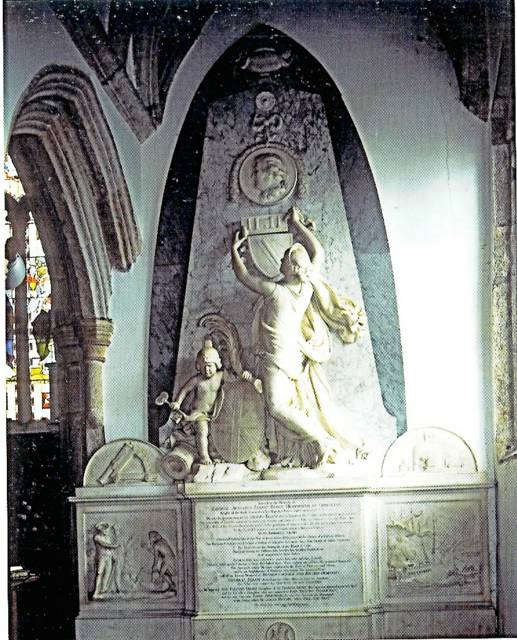
Heathfield Memorial: Once despised?


Excerpt from " A guide to St Andrew's Church, Buckland Monachorum"

"Behind the chapel altar, and now rather difficult to see, is a huge monument, once despised, but now recognised as an outstanding example of the work of John Bacon, the 18th Century artist whose monuments also appear in Westminster Abbey and St. Paul's Cathedral. The subject of this particular monument is General Elliott, who successfully defended Gibraltar during the long siege by Spain, from 1770 to 1783. As Baron Heathfield he is buried at Heathfield in Sussex. He had married Lady Anne Drake, and their son inherited the Buckland Abbey estates when the last surviving male of the Drakes died childless. The monument to Francis August Elliott, second Baron Heathfield which was designed by John Bacon, Junior is to be seen on the wall adjacent, next to that of Francis Henry Drake, whose estates he inherited.

At a time when this country's fortunes were at a very low ebb, General Elliott's defence of Gibraltar became a symbol of steadiness, courage and endurance. The amazing details depicted on his memorial well repay careful scrutiny. In order to position the memorial, a door and a window of the chapel had to be blocked up and their outline can be seen from outside. The faculty was granted on condition that a new door on the south wall was made. This little door is still there, but is not used nowadays."

Why was the memorial "once despised"? Was it because of the structural changes that were made to the chapel in order for it to be installed? Was it that the subject matter, miltary defense/war, was deemed inappropriate for the house of God?

Heathfield Memorial, Buckland Monachorum, Devon. Posted by Hello

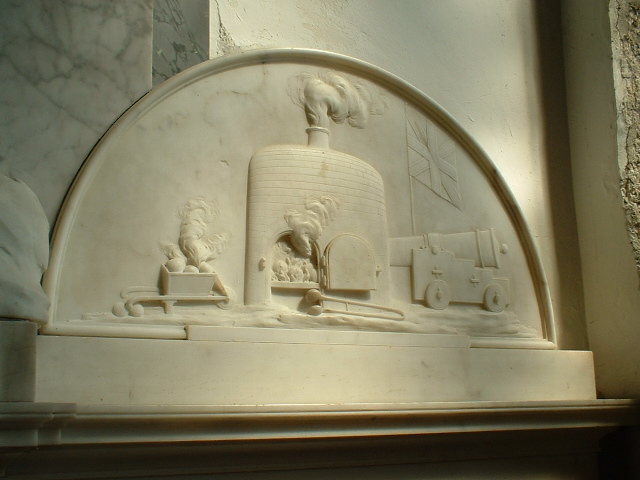
Detail of Memorial to Lord Heathfield, erected by his nephew Major Thomas Trayton Fuller Eliott Drake. St Andrew's Church, Buckland Monachorum, Devon. Sculpture by John Bacon RA, London 1795. © Annette Lloyd Thomas, 2003. Posted by Hello

How to Prepare for a Siege by Lord Heathfield

In 1775 George Augustus Eliott, Lord Heathfield (1717 - 1790), was appointed Governor of Gibraltar. During the siege of 1779-83 he held the British fortress against Spanish attack, and was made Baron Heathfield 6 July 1787.

"The system of his life, as well as his education, particularly qualified him for this trust. He was perhaps the most abstemious man of the age. His food was vegetables, his drink water. He neither indulged himself in animal food nor wine. He never slept more than four hours at a time so that he was up later and earlier than most men. He had also inured himself to habits of severity that the things which to others are painful, were to him of daily practice and rendered agreeable to use".

Burke's Dormant & Extinct Peerages of the British Empire, pp 188.

Heathfield had a very distiguished military career. In 1759 he formed the King's Light Dragoons and commanded until 1789. During the peace between 1763 and 1775, general Elliot served for a time as commander of the forces in Ireland. He was nicknamed "Old Cock of the Rock" after his sucessful defence of Gibraltar.

Lord Heathfield died at Aix-la-Chapelle, July 6, 1790, of a second stroke of palsy, while endeavouring to reach Gibraltar, where he was anxious to close his life.

Wednesday, September 15, 2004

The Henrietta Marie: setting the record straight


The Henrietta Marie was a slave ship that sank in the Florida Strait in June of 1700. Her wreck was discovered by treasure hunter Mo Molinar in 1972 but not identified until 1983 when a group of marine archaeologists revisited the site. In 1992 journalist Michael H Cottman started investigating her history. He published an article "The Ghosts of the Henrietta Marie" in the Washington Post on Sunday 7 February, 1999. Cottman writes that, "The Henrietta Marie also carried eight large cannons, commissioned by John "Mad Jack" Fuller, a wealthy arms dealer and Jamaican plantation owner who had a lucrative investment in the slave trade." The John Fuller (1680-1745) who was iron master at Heathfield, where cannons were made, was Jack Fuller's grandfather.
There is no doccumentation to support the notion that John Fuller ever went to Jamaica. His son Stephen (1716-1799), "went into the sugar trade, and from 1760 until his death in 1799 he was the agent in London for the Jamaica assembly." Crossley & Saville, pp. xxv. "Thomas Fuller, named after Thomas Isted [his uncle], was established as a sugar-baker in London , and eventually conducted a wide trade with the island." Crossley & Saville, pp. xxv. Rose Fuller's involvement with the Jamaica Plantations is detailed in this September 14, 2004 blog post.

To set the record straight: Jack Fuller could not have "commissioned" any cannons in the 1690's as he was born in 1757. He did not have any children so was not the father of Stephen and Rose.

Monday, August 16, 2004

Mad Jack Fuller's Obituary


Gentleman's Magazine
July 1834 pp 106 - 107

JOHN FULLER, Esq.
April 11. In Devonshire place, aged
77, John Fuller, Esq. of Rose Hill, Sus-
sex, formerly M.P. for that county.
This gentleman was the son of John
Rose Fuller, esq. He succeeded in es-
tate his uncle Rose Fuller, Esq. M.P.
for Rye (ob. 1777) who was the younger
son of Mr. Thomas Fuller, the purchaser
of the estate, and builder of the house,
Rose Hill, by Elizabeth, daughter of Mr.
Rose, of Jamaica.
Mr. Fuller was first elected to Parlia-
ment for Southampton in Feb. 1780, and
having been rechosen at the general elec-
tion of the same year, he sat for that town
until the dissolution in 1784. He served
the office of Sheriff of Sussex in 1797.
In 1801, on the elevation to the peer-
age of the Rt. Hon. T. Pelham (by the
title of Earl of Chichester), Mr. Fuller
became a candidate for the representation
of the county of Sussex, and was success-
ful after an arduous contest with Col.
Sergison, which lasted sixteen days, and
cost him 20,000 l. in addition to a sub-
scription purse for 30,000 l. made by the
county. He was re-chosen in 1802, 1806,
and 1807, and sat until the dissolution of
1812. He generally voted with Mr. Fox;
and is said to have indignantly refused
the offer of a peerage from Mr. Pitt,
deeming it a trial of his integrity. It is
related that he threw the Minister's
into the fire, in the presence of a large
party of friends, declaring "I was born
Jack Fuller, and Jack Fuller I will die!"
In 1810, during the inquiry on the
Walcheren expedition, Mr. Fuller got
embroiled in an insane contest with the
supreme authority of the House of Com-
mons. On the 22d of Feb. he was re-
peatedly called to order; but on the 27th
no appeal from the Speaker or remon-
strances from his friends, could restrain
him within the bounds of propriety.
The House was in consequence resumed
from the Committee into which it had of
resolved itself, and Mr. Fuller was
immediately voted into the custody of
the Sergeant at Arms; when he vio-
lently rushed into the House, vehemently
asserting that the Speaker, whom he
designated as "the little insignificant
fellow in the wig," was the servant of the
House, and had no authority over the
Members, who had converted him into
their Master. He was at length carried
off the field by the united efforts of four
of the messengers of the House. He
remained two days in custody; and was
then discharged with a very severe repri-
mand from the Speaker, who threatened
him with summary expulsion on a repe-
tition of his offence. After this memo-
rable scene, he was not returned to ano-
ther Parliament.
Mr. Fuller was distinguished through
life by much eccentricity; but it was
mingled with a kind heart, that displayed
itself in deeds of princely munificence.
The favourite object of his liberality was
the Royal Institution, where he first
founded a Professorship of Electricity,
in the year 182.., and subsequently, a
few weeks before his death, a Professor-
ship of Comparative Anatomy and Phy-
siology. He also gave the Institution at
the same time the sum of 3000 l. to accu-
mulate in the funds; making the sum
total of his benefactions amount to
10,000 l. On the 24th of March last the
members were specially convened to
thank him; and it was resolved that a
age of the Rt. Hon. T. Pelham (by the
subscription should be made for a Bust
of their munificent Patron, to be placed
in a prominent situation in this Institution.
Mr. Fuller erected an observatory at
his house of Rose Hill About twenty
years ago it was expected that he would
promote the publication of a history of the
three Eastern rapes of Sussex; for which
it was supposed that the large collections
of the Rev. Mr. Hayley, which were in
his possession, would furnish very exten-
sive materials.
Mr. Fuller has died extremely rich.
The bulk of his fortune, consisting of
estates in Sussex and in the island of
Jamaica, are left to Augustus Elliot
Fuller, esq. brother to Capt. Fuller,
R.N. and a nephew of the deceased, as
also of Lord Heathfield. The estates in
London are left to Sir Peregrine Palmer
Acland, Bart. another nephew. He has
also left very numerous legacies. His
remains were taken to the family vault at
Brightling in Sussex for interment, at-
tended out of London by twenty-four pri-
vate carriages.

Corrections by Annette Lloyd Thomas: Jack Fuller's Father was the Rev. Henry Fuller (1713-1761). Rose Fuller (1708-1777) was the son of John Fuller (1680-1745) and Elizabeth Rose (1681-1726). Thomas Fuller (1655-1720) bought the mansion at Brightling c. 1697. He left the property to his nephew John Fuller (1680-1745) who named the estate Rose Hill in honour of his wife Elizabeth Rose, the daughter of Dr. Fulke Rose of Jamaica.
Jack Fuller founded the Professorship of Chemistry in 1833 (not of Electricity) and the Professorship of Comparative Anatomy and Physiology in early 1834. The observatory at Brightling is not at the mansion at Rose Hill but nearby on the Brightling-Burwash road. Augustus Elliot Fuller was not technically a nephew - he was the son of Jack Fuller's first cousin John Trayton Fuller.
Sir Peregrine Palmer Acland was the son of Jack Fuller's sister Elizabeth and her husband Sir John Palmer Acland.

Wednesday, December 24, 2003

BRIGHTON GAZETTE

17 April 1834, page 3

The Late John Fuller, Esq.

We regret to announce the death, on Friday last, at his
residence in London, after a tedious illness, of John Fuller,
Esq., of Rose Hill, in this county, aged 78 years. This
gentleman, better known by the name of "Honest Jack
Fuller," represented the county of Sussex during several
successive Parliaments, for a period of more than twenty
years, and was made celebrated by a well-known scene in the
House of Commons, -- when he called the Speaker " a little
insignificant fellow in a wig," -- for which he was committed
to the custody of the Sergeant-at-arms. He was distin-
guished throughout life by much eccentricity, mingled with
a kind heart that displayed itself in actions of princely
munificence: of this his splendid benefactions to the Royal
Institution are only one example.
Mr Fuller died extremely rich. The bulk of his fortune,
consisting of estates in Sussex and the island of Jamaica,
are left to Augustus Elliot Fuller, Esq., brother of Captain
Fuller, R. N.
, and a nephew of the deceased, as also of Lord
Heathfield
. The estates in London are left to Sir Peregrine
Acland
, another nephew. Besides which there are very
numerous legacies.
The following anecdote, which may be relied on, of Mr
Fuller, is not generally known. During Mr Pitt's adminis
tration a messenger arrived at Rose Hill with the offer of a
Peerage, on the condition that Mr Fuller should vote in a
particular manner on some question of the day. Mr Fuller,
who at the moment had a large party of friends assembled
at his dinner table, directed the messenger to be ushered
into the dining room to receive his answer. In his presence
and that of his guests, Mr Fuller threw the letter into the
fire telling the messenger at the same time to acquaint the
Minister with the manner in which his offer had been re-
ceived, and adding -- "I was born Jack Fuller, and Jack
Fuller I will die."
The tenants are to meet the funeral at Robertsbridge on
Saturday, and accompany it to the mausoleum built by Mr
Fuller at Brightling, where his remains will be interred.
Mr Fuller stood successfully a severely contested election
with Colonel Sergisson, which lasted sixteen days, and cost
the former 20,000l., in addition to a subscription purse of
30,000l., made by the county. The expences incurred by
Mr Sergisson were, we believe, equally heavy.

Wednesday, December 10, 2003

Extract from "Highways & Byways in Sussex" by E.V. Lucas

Pages 380-381, Macmillan and Co, Limited 1912

Four miles west of Robertsbridge, up hill and down, is Brightling, whose Needle, standing on Brightling Down, 646 feet high, is visible from most of the eminences in this part of Sussex.
The obelisk, together with the neighbouring observatory, was built on the site of an old beacon by the famous Jack Fuller - famous no longer, but in his day (he died in 1834 aged seventy-seven) a character both in London and in Sussex. He was big and bluff and wealthy and the squire of Rose Hill. He sat for Sussex from 1801 to 1812, and was once carried from the house by the Sergeant at Arms and his minions, for refusing to give way in a debate and calling the Speaker "the insignificant little fellow in a wig." His election cost him £10,000 plus £30,000 subscribed by the county. When Pitt offered him a peerage he said no: "I was born Jack Fuller and Jack Fuller I'll die." When he travelled from Rose Hill to London Mr. Fuller's progress was almost regal. The coach was provisioned as if for arctic exploration and coachman and footmen alike were armed with swords and pistols. ("Honest Jack," as Mr Lower remarks, put a small value upon the honesty of others.) Mr. Fuller had two hobbies, music and science. He founded the Fullerian professorships (which he called his two children), and contributed liberally to the Royal Institution; and his musical parties in London were famous. But whether it is true that when the Brightling choir dissatisfied him he presented the church with nine bassoons, I cannot say.
John Fuller has a better claim to be remembered in Sussex by his purchase of Bodiam Castle, when its demolition was threatened, and by his commission to Turner to make pictures in the Rape of Hastings, five of which were engraved and published in folio form in 1819, under the title Views in Sussex. One of these represents the Brightling Observatory as seen from Rosehill Park. As a matter of fact, the observatory, being of no interest, is almost invisible, although Mr. Reinagle, A.R.A., who supplies the words to the pictures, calls it the "most important point in the scene". Furthermore, he says that the artist has expressed a shower proceeding "from the left corner". Another picture is the Vale of Ashburnham, with the house in the middle distance, Beachy Head beyond, and in the foreground woodcutters carrying wood in an ox waggon. "The whole," says Mr. Reinagle, A.R.A., "is happily composed, if I may use the term." He then adds: "The eye of the spectator, on looking at this beautifully painted scene, roves with an eager delight from one hill to another, and seems to play on the dappled woods till arrested by the seat of Lord Ashburnham." Other picutes in the folio are "Pevensey Bay from Crowhurst Park," a very beautiful scene, "Battle Abbey," and " The Vale of Heathfield," painted from above the road, with Heathfield House on the left, the tower on the right, the church in the centre in the middle distance, and the sea on the horizon: an impressive but not strictly veracious landscape.
In Brightling church is a bust to John Fuller, with the motto: "Utile nihil quod non
honestum." A rector in Fuller's early days was William Hayley, who died in 1789, a zealous antiquary. His papers relating to the history of Sussex, are now, like those of Sir William Burrell, in the British Museum.

Monday, January 27, 2003

East or West

I came across this quote from David Blayney Brown:

"Probably in the same year [1809] Turner visited Sussex landowner, Jack Fuller at Rosehill Park, Brightling to begin work on a picture of the estate.
It was possibly Fuller who commissioned the series of watercolours of West Sussex which were later engraved as Views in Sussex."

The question is surely Brown means East Sussex - as the pictures show Brightling Park, the Vale of Heathfield, the Vale of Ashburnham, Pevensey Bay and Battle Abbey - all firmly in East Sussex.

"The Art of JMW Turner", David Blayney Brown, Knickerbocker Pr; ISBN: 1577150309

Sunday, January 19, 2003

Where is the Portrait of George Augustus Elliot, Lord Heathfield, Governor of Gibraltar?

Michel-Edouard Nigaglioni, Conservator of Historic and Artistic Patrimony of Bastia, Corsica, is researching the work of 18th Century Corsican painter Anthony de Poggi. Of particular interest is a painting called "George Augustus Elliot, Lord Heathfield, Governor of Gibraltar", 10 Sep 1788. An engraving of this work by Francesco Bartolozzi is owned by the National Maritime Museum at Greenwich, London. Nigaglioni would like to know the whereabouts of the original painting.

Anthony de Poggi lived in London where he was a publisher and print seller. He exhibited his works at the Royal Academy from 1776 to 1781. Many portraits were done of George Augustus Eliott in 1787, the year he was raised to the peerage of Baron Heathfield of Gibraltar.

Lord Heathfield appears in John "Mad Jack" Fuller's family tree. George Augustus Eliott's daughter, Anne Eliott married Fuller's first cousin John Trayton Fuller on 21 May 1777. Their son Augustus Elliot Fuller inherited Rose Hill from Mad Jack. Augustus Elliot Fuller was MP for Sussex from 1841 until his death in 1857.

Wednesday, July 31, 2002

Fuller Gunfounding

"In the seventeenth and eighteenth centuries the government relied almost exclusively on Wealden production for its requirements of cast iron ordnance. Guns made by the Fullers at Heathfield were put to service in many parts of the world."

Teesdale, E. B., Gunfounding in the Weald in the Sixteenth Century
(London: Royal Armouries, 1991) ISBN 0-948092-17-3