"As usual, Sussex can claim its share of interesting things, and when it comes to "Follies," our county possesses some that are unique. The most compact group of these curiosities are those in the neighbourhood of Brightling and Dallington, the work of Squire "Jack" Fuller who made a hobby of erecting these "megalithic" monuments on his native heaths and hills. He was a real "character" with a will of his own. He succeeded to a great fortune at an early age, and there is no little doubt that lack of parental control lead to his subsequent eccentricities. He represented the County in Parliament from 1801-1812, was reprimanded for insulting the Speaker, and refused a peerage, rather than desert his party. He had two hobbies, music and science, and was a patron of literature. It was he who saved Bodiam Castle from demolition and he who encouraged Turner, the artist. He liked to be known as "Honest Jack," but apparently did not rely on the honesty of others. His progress from London to Brightling was almost regal. The coachmen and footmen were armed with pistols and swords, and the coach provisioned as if for an expedition into the wilds.
Altogether a most interesting man, and one whose story was related in a early number of the S.C.M. [Sussex County Magazine], but how many would take the trouble to look up his record were it not for the constant reminder afforded by some of the strange monuments he erected?
On Brightling Down, 646 ft. high, stands an obelisk known as the "Needle," built on the site of an old beacon which blazed its warning of the coming of the Armada, and later, prepared to warn Sussex of the coming of Napoleon. From this Needle--a great landmark--a superb panorama interrupted only by woods on the S.E. is obtained. At Dallington, nearby, is a conical, two storied building known as the "Sugar Loaf." The Observatory, built from the designs of Sir Robert Smirke, stands on Brightling Down. This same architect designed the ugly pyramid, Fuller's mausoleum, in Brightling churchyard.
Curious tales are told of "Jack" Fuller. It is said that he sought for a hermit to occupy the mausoleum for one year, during which he was not to shave, wash cut his hair, or hold any intercourse with the outer world. After this ordeal, he was to be made a gentleman for life. There were no offers!
It is also said when he was laid to rest in his strange tomb--in 1834, aged 77--he was placed, by desire, in an iron chair, with broken glass strewn all around. He feared that the Devil would come to claim his own, and in doing so, would cut his hooves on the glass!
Both of the two foregoing stories are, in all probability, just idle legends engendered by the eccentric habits of the Squire. In many respects, his foibles were exaggerated. Take for example the massive miles-long wall surrounding his estate (Rose Hill: named after his wife)*. Not many tourists, who come in motor-coaches in the summer, notice this. Those who do may think it another of his "follies". One is not so sure. Like other Grand Old English Gentlemen, Jack had more than his share of poor men at the gate, some of whom professed to be out-of-work masons and labourers. Rather than give them his charity, he created this artificial job. The more the beggars came, so did the wall grow, until it reached the proportions seen to-day."
SOME SUSSEX "FOLLIES" by William A. Bagley, Sussex County Magazine, Volume 11, March 1937, Number 3, pp 171- 176.
* Note: John "Mad Jack" Fuller 1757-1834 never married. The Rose Hill estate in Brightling was named by his grandfather, John Fuller 1680-1745 for his wife Elizabeth Rose, Mad Jack's grandmother.
Other Sussex follies mentioned in this article:
i. Holmbush Beacon Tower, at Colgate in St Leonard's Forest
ii. Racton Monument, Rowlands Castle Station
iii. Gibraltar Tower, Heathfield Park
iv. Toat Monument, near Pulborough
v. A gateway at Nore, Hill, Slindon
vi. Castelated Tower, at Michelgrove near Patching
vii. Firle Tower, West Firle
viii. Signaling Tower, Selsfield Common, near Turner's Hill
ix. Pepper Box, in Queen's Park, Brighton
x. Tower at Shillinglee Park, near North Chapel
Sunday, June 28, 2015
Monday, April 06, 2015
Waterloo: The Aftermath by Paul O'Keeffe

"Just a week after the dispatch arrived, at one o'clock on 28 June [1815], a large gathering of 'MERCHANTS, BANKERS,TRADERS and others' assembled at the City of London Tavern in Bishopsgate Street, 'to consider the propriety of a PUBLIC SUBSCRIPTION for the RELIEF of the SUFFERERS in the late GLORIOUS BATTLES'. The first to donate was a
Mr. John Fuller, who promised 200 guineas and made a speech hoping that other gentlemen would follow his example 'and leave off buying baubles and nonsense, and a pack of fooleries, at the sales and exhibitions of Bond Street'. The hundred or so individuals and businesses represented at he meeting subscribed immediately the further sum of £9,4898. On 30 June, the fund had increased to £21,216, an week later to £38, 171, and by 13 July it stood at £74,540. 11s. 8d. The Morning Post of 9 August
published some lines of verse ON THE WATERLOO SUBSCRIPTION REACHING THE SUM OF ONE HUNDRED THOUSAND POUNDS:
Hail, Britain! Thy bounty beyond all dispute,
Must with wonder strike other lands dumb;
When they see that thy heroes, as a victory's fruit,
Receive from they kindness a plumb. *
A plumb for those who fought and bled,
Already they declare;
But some have confidently said,
We'll make that plumb a pair.
*PLUMB: An hundred thousand pounds (a Classical Dictionary of the Vulgar Tongue, 2nd Edition, corrected and enlarged, 1788)"
Source - Waterloo: The Aftermath by Paul O'Keeffe, published by The Bodley Head, 2014, Page 147.
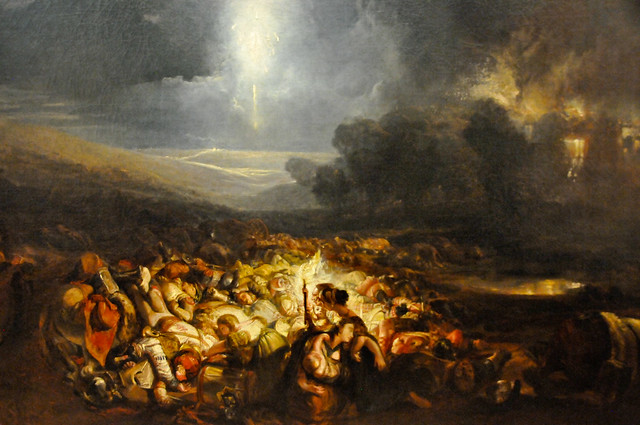
Painting: The Field of Waterloo by JMW Turner, Tate Britain.
Sunday, March 22, 2015
FUNERAL OF THE LATE JOHN FULLER ESQ.
On Saturday last, the remains of this lamented gentleman were conveyed to the tomb, at Brightling, in this county. Precisely at two o'clock the procession arrived at the church, and presented one of the most imposing spectacles ever witnessed in that part of the country. The melancholy procession was preceded by a number of girls, dressed in dark coloured frocks, with broad white collars, these were followed by boys, habited in white round frocks, black crape hatbands and gloves -- next came about 66 men (workmen, we believe, on the estate of the deceased) clothed in new white round frocks, crape hatbands and black gloves -- after these were about 100 mounted horsemen, in black cloaks and silk hatbands -- plume of feathers, mutes &c. The hearse, drawn by six horses, hung with silk escutcheons of the family arms -- the carriage of the deceased with the blinds closed drawn by six horses -- three or four mourning coaches -- followed by a number of gentlemen's carriages. As soon as the procession arrived at the church gate, those who preceded the hearse formed an avenue to the church, through which the body was borne by eight men; the coffin was covered with a most superb pall, decorated with silk escutcheons. Immediately the body entered the church yard, the fine organ (gift of the deceased), commenced a solemn dirge, and the usual service was performed; the body was then removed to the place destined for its reception, a large high pyramid, similar, but in miniature, to those of Egypt. The day being fine, a vast number of sorrowing well dressed persons, of both sexes, amounting to 5,000 were present on the melancholy occasion.
THE SUSSEX ADVERTISER 21 April 1834, page 3
Saturday, March 07, 2015
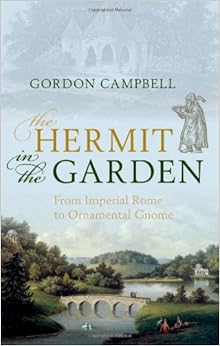
The Hermit in the Garden: From Imperial Rome to Ornamental Gnome

by Gordon Campbell, Oxford University Press, 2013
"In 1777 John Fuller, who is popularly but inaccurately known
as Mad Jack Fuller (he seems to have been wholly sane), inherited from his
uncle the family estate of Rose Hill, in Brightling (Sussex). After a tumultuous political career, in the
course of which he defended he living conditions of plantation slaves (he owned
a plantation in Jamaica) and was ejected from the House of Commons for
drunkenness, Fuller left parliament at the dissolution of 1812 and settled at
Rose Hill, where he had already embarked on the construction of a memorable set
of follies. He began with a Coadestone (i.e. ceramic) summer house with a ‘Tudor’
arch (restored in 1992) and went on to commission his own mausoleum (an 8-metre
high pyramid in Brightling churchyard), a rotunda garden temple, an obelisk
known as the Needle, a hermit’s tower and a building known as the Sugar Loaf
(an 11-metre cone which alludes to his sugar plantation).
The 8-metre hermit’s tower was built with a view to accommodating
an ornamental hermit, and Fuller is said to have advertised for a hermit with
the usual conditions of service. Here,
for example is the account in Follies: A National Trust Guide:
"The
requirements were a little excessive: no shaving, no washing, no
cutting
of hair and nails, no conversation with any outsider for a period
of
seven years, after which the happy hermit would be made a Gentleman.
No
takers.”
[No page numbers give in ebook version]
Georgian Garden Buildings by Sarah Rutherford with Jonathan Lovie
Shire Publications, 2012
John Fuller’s Brightling follies and other buildings are not mentioned but it is easy to map out into which chapters they would appear.
Chapter
|
Fuller’s Building
|
Columns
| |
Gates
| |
Mausolea and Monuments
| |
Obelisks
| |
Rotundas
| |
Temples and Pavilions
| |
Towers
|
The suggestion that Fuller advertised for a hermit to live in the tower seems to have been made long after the fact, so I would not include the tower in the “Hermitages and Root Houses” chapter.
The Sugar Loaf, on the other hand, is not so easy to categorize. Legend has it that Fuller had this cone-shaped folly built to win a wager that he could see the spire of St. Giles, Dallington from his home, Rose Hill.
Subscribe to:
Posts (Atom)