Tuesday, December 21, 2004
Heathfield Memorial: Once despised?
Excerpt from " A guide to St Andrew's Church, Buckland Monachorum"
"Behind the chapel altar, and now rather difficult to see, is a huge monument, once despised, but now recognised as an outstanding example of the work of John Bacon, the 18th Century artist whose monuments also appear in Westminster Abbey and St. Paul's Cathedral. The subject of this particular monument is General Elliott, who successfully defended Gibraltar during the long siege by Spain, from 1770 to 1783. As Baron Heathfield he is buried at Heathfield in Sussex. He had married Lady Anne Drake, and their son inherited the Buckland Abbey estates when the last surviving male of the Drakes died childless. The monument to Francis August Elliott, second Baron Heathfield which was designed by John Bacon, Junior is to be seen on the wall adjacent, next to that of Francis Henry Drake, whose estates he inherited.
At a time when this country's fortunes were at a very low ebb, General Elliott's defence of Gibraltar became a symbol of steadiness, courage and endurance. The amazing details depicted on his memorial well repay careful scrutiny. In order to position the memorial, a door and a window of the chapel had to be blocked up and their outline can be seen from outside. The faculty was granted on condition that a new door on the south wall was made. This little door is still there, but is not used nowadays."
Why was the memorial "once despised"? Was it because of the structural changes that were made to the chapel in order for it to be installed? Was it that the subject matter, miltary defense/war, was deemed inappropriate for the house of God?


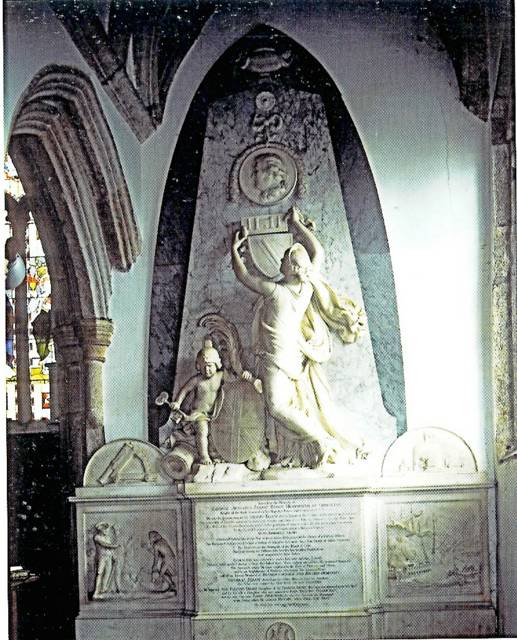

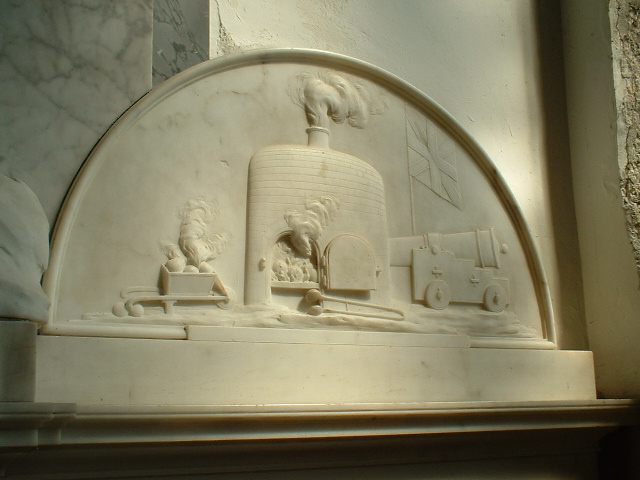
How to Prepare for a Siege by Lord Heathfield
In 1775 George Augustus Eliott, Lord Heathfield (1717 - 1790), was appointed Governor of Gibraltar. During the siege of 1779-83 he held the British fortress against Spanish attack, and was made Baron Heathfield 6 July 1787.
"The system of his life, as well as his education, particularly qualified him for this trust. He was perhaps the most abstemious man of the age. His food was vegetables, his drink water. He neither indulged himself in animal food nor wine. He never slept more than four hours at a time so that he was up later and earlier than most men. He had also inured himself to habits of severity that the things which to others are painful, were to him of daily practice and rendered agreeable to use".
Burke's Dormant & Extinct Peerages of the British Empire, pp 188.
Heathfield had a very distiguished military career. In 1759 he formed the King's Light Dragoons and commanded until 1789. During the peace between 1763 and 1775, general Elliot served for a time as commander of the forces in Ireland. He was nicknamed "Old Cock of the Rock" after his sucessful defence of Gibraltar.
Lord Heathfield died at Aix-la-Chapelle, July 6, 1790, of a second stroke of palsy, while endeavouring to reach Gibraltar, where he was anxious to close his life.
Wednesday, September 15, 2004
The Henrietta Marie: setting the record straight
The Henrietta Marie was a slave ship that sank in the Florida Strait in June of 1700. Her wreck was discovered by treasure hunter Mo Molinar in 1972 but not identified until 1983 when a group of marine archaeologists revisited the site. In 1992 journalist Michael H Cottman started investigating her history. He published an article "The Ghosts of the Henrietta Marie" in the Washington Post on Sunday 7 February, 1999. Cottman writes that, "The Henrietta Marie also carried eight large cannons, commissioned by John "Mad Jack" Fuller, a wealthy arms dealer and Jamaican plantation owner who had a lucrative investment in the slave trade." The John Fuller (1680-1745) who was iron master at Heathfield, where cannons were made, was Jack Fuller's grandfather.
There is no doccumentation to support the notion that John Fuller ever went to Jamaica. His son Stephen (1716-1799), "went into the sugar trade, and from 1760 until his death in 1799 he was the agent in London for the Jamaica assembly." Crossley & Saville, pp. xxv. "Thomas Fuller, named after Thomas Isted [his uncle], was established as a sugar-baker in London , and eventually conducted a wide trade with the island." Crossley & Saville, pp. xxv. Rose Fuller's involvement with the Jamaica Plantations is detailed in this September 14, 2004 blog post.
To set the record straight: Jack Fuller could not have "commissioned" any cannons in the 1690's as he was born in 1757. He did not have any children so was not the father of Stephen and Rose.
Subscribe to:
Posts (Atom)

