Wednesday, January 05, 2005

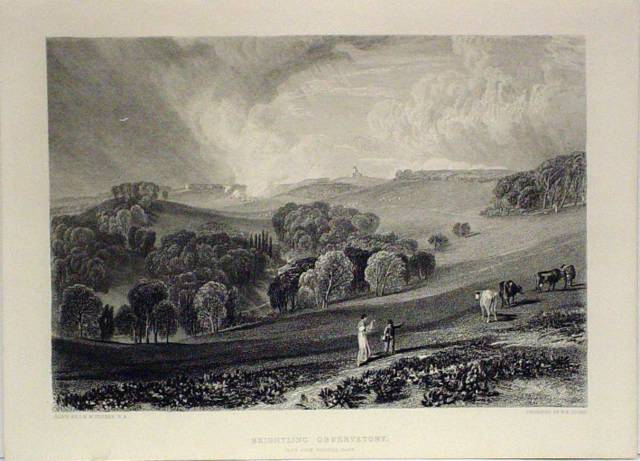
Brightling Observatory, Engraving/Etching - William Bernard Cooke
from Painting - Joseph Mallord Turner

 Posted by Hello

Fuller & Turner

"Between 1810 and the early 1820s Turner worked closely for two very different patrons, whose quite specific interests were given lasting form as a result of their connection with the artist. The first was John Fuller (known as 'Mad Jack': 1757-1834), who was the Tory MP for Sussex between 1801 and 1812. Like Beckford, his wealth derived from sugar plantations in the West Indies, and he was accordingly a vocal supporter of slavery. The connection with Turner began in 1810 with a request for a set of four watercolours showing Fuller's Sussex estate, Rosehill, and those of other neighbouring country houses. At much the same time Turner produced an oil painting of Rosehill though this is perhaps the least involving of his country house pictures; the strongly delineated areas of shadow across the middle distance creates an awkward transition, as the eye travels towards the distant speck of the mansion. He subsequently painted further views recording the lush undulating landscape to the north and west of Hastings, much of which was owned by Fuller. One of these later watercolours includes the observatory Fuller constructed high on the brow of a hill in Brightling Park, where he pursued his amateur interest in astronomy. However, its diminutive scale in the image suggests that Turner used the commission to emphasize the beauties of the scenery, instead of the characteristic interests of his patron. "

Turner at Petworth, Christopher Rowell, Ian Warrell & David Blayney Brown, pp. 52

Thursday, December 30, 2004

John Fuller and William Cobbett


"Fuller continued to show a keen interest in the state of farming and on January 3, 1822, he attended a meeting of over 300 farmers and landed gentlemen at The George Hotel in Battle, who had gathered to protest over the 'distressed state of agricultural interest', which they believed had been brought about by the Corn Laws of 1815. Fuller put forward several resolutions, bemoaning 'the fallen state of the landed interest' and pleaded for some form of relief. Present at the meetings was William Cobbett, radical journalist, Member of Parliament and author of Rural Rides, who delivered a supportive speech to the gathering, in which he sympathised with their cause but felt there was little could be done to change the situation. The Corn Laws were not abolished until 1846."
Fuller of Sussex: A Georgian squire, by Geoff Hutchinson, pp. 92.

So we establish that Fuller met Cobbett although Hutchinson does not give any sources. He is also getting ahead of himself as Cobbett, despite a number of attempts, was not a member of Parliament until 1832. Rural Rides was not published in full until 1830 although he had started the rides in the early 1820's and they were serialised in his publication The Register.
We know from the Penguin edition of Rural Rides that Cobbett was elsewhere in Sussex at about this time: "The younger [John] Ellman was also a Sussex farmer, but angered Cobbett by calling for tougher corn laws and by expressing his loyalty to the government. There was a near outbreak of fisticuffs between Cobbett and farmers at a meeting of Sussex farmers at which the younger Ellman was prominent."
This meeting took place at Lewes on 9 January 1882, a week after the meeting at Battle. In fact there were two events - a meeting at the County Hall followed by a dinner at the Star Inn. Cobbett had been warned not to go to Lewes where his criticisms of the farmers would not be welcome. Being Cobbett he liked nothing better than to face down his critics. The meeting at County Hall passed off relatively peacefully. Cobbett was urged to attend the dinner - "...being pressed to go, I finally went." He met with hostility and a proposal that he "be put out of the room!" Despite this Cobbett rose to speak pointing out forcefully the plight of the farm labourers and facing down his opponents. He was exultant.
"...but Cobbett rejoiced in his achievements: 'I beat the cocks upon their own dung-hill', he wrote privately. Eight years later, during the Captain Swing revolts, the Sussex landholders came to see that in rejecting Cobbett in 1822 they had rejected the wants and aspirations of an entire class of agricultural workers." See Dyck, Cobbett and Rural Popular Culture, pp. 70-72.

What happened at Brightling during the Swing Riots? Does anybody know?

Wednesday, December 29, 2004

Eccentric Britain: A celebration of Britain's bizarre buildings, peculiar places and offbeat events

By Des Hannigan, photography by Chris Coe

A fun and interesting look at what makes Britain unique and a wonderful tourist destination. The text however, does not live up to the standards of the photographs. The author's motto appears to be, "Never let the truth get in the way of a good story".

Fuller's Fabulous Follies, pp.61 -62
Brightling, Sussex

Corrections:

"Down on the Downs round Brightling" - Brightling is located on the High Weald which commands a pleasant view of the South Downs.

"Mad Jack was born in 1757 into a wealthy ironfounding family that made its fortune from slavetrading and producing guns for the British Navy " - The Fuller family certainly made money from its sugar plantations in Jamaica which were worked by slaves. But to say they were slave traders is stretching the point.

"Legend says that Jack's corpse was perched on an iron chair inside the tomb..." - This was discovered to be untrue during renovations in 1982. Fuller is indeed buried in the conventional manner beneath the pyramid as directed in his will.

"Never go anywhere on an empty stomach was Jack's motto." - John "Mad Jack" Fuller's motto was 'Utile nihil quod non henestrum' - Nothing is of use which is not honest.

"Before his friends woke up he sent his workers to erect the top of a false steeple out of stones and clay". - It is not possible that the Sugarloaf was erected in just a few hours.

Saturday, December 25, 2004

Willie the Gardener


Sir William Lawrence Bragg was the youngest recipient ever of a Nobel Prize when he shared the honour with his father Sir William Henry Bragg in 1915. The Nobel Prize was for Physics although both father and son where made Fullerian Professors of Chemistry (William Henry Bragg in 1923, William Lawrence Bragg in 1953).

Excerpt from What Mad Pursuit by Francis Crick (Basic Books, 1988):

"The current Cavendish Professor was Sir Lawrence Bragg (known to his close friends as Willie), the formulator of Bragg's law for X-ray diffraction..... Bragg was one of those scientists with a boyish enthusiasm for research, which he never lost. He also was a keen gardener. When he moved in 1954 from his large house and garden in West Road, Cambridge, to London, to head the Royal Institution in Albemarle Street, he lived in the official apartment at the top of the building. Missing his garden, he arranged that for one afternoon each week he would hire himself out as a gardener to an unknown lady living in The Boltons, a select inner-London suburb. He respectfully tipped his hat to her and told her his name was Willie. For several months all went well till one day a visitor, glancing out of the window, said to her hostess, 'My dear, what is Sir Lawrence Bragg doing in your garden?' "

(with thanks to Pastor Doug Kramer)